

Vietnam’s dynamic economy and rapidly expanding workforce have long made it an attractive destination for foreign investors looking to establish headhunting, staffing, and human resources consulting firms. However, historically, navigating the legal requirements to operate in this sector has been a complex endeavor, characterized by stringent pre-approvals, mandatory capital lock-ups, and rigid sub-licenses.
A monumental legal shift is about to change this landscape entirely. Beginning July 1, 2026, the Vietnamese government will implement Resolutions 66.17/2026/NQ-CP and 66.18/2026/NQ-CP. These breakthrough legislative documents are designed to aggressively cut red tape, ultimately removing employment services from the list of conditional business lines.
Why should you care about this?
Because it fundamentally transforms how you will set up a recruitment company in Vietnam 2026. The new regulations eliminate the requirement for a separate Recruitment License, the requirements for the Legal Representative, and the mandatory 300 million VND deposit.
In this article, we will analyze the exact legal changes brought about by these new resolutions. We will explore the transition from a strict sub-license obtaining to a operational checking framework, compare the old and new establishment processes, and provide actionable strategic advice to ensure your recruitment firm launches seamlessly and remains fully compliant in the Vietnamese market.
Key Takeaways
- Abolition of the Sub-License: Understand how Resolutions 66.17/2026/NQ-CP and 66.18/2026/NQ-CP remove the need for an Recruitment License starting July 1, 2026.
- No More Escrow Deposit: Learn about the removal of the 300 million VND mandatory bank deposit requirement.
- Temporary Relief Measures: Understand the legal nature of these Resolutions as temporary, time-bound measures waiting to be officially codified into Law.
- The Shift to operational checking: Discover what operational compliance recruitment entails, including new reporting and data integration obligations.
- Actionable Setup Steps: Get a clear, step-by-step roadmap for foreign investors entering and operating in the market under the new changes.
In-Depth Legal Framework: Anatomy and Fragmentation of the New Rules
Navigating the Vietnamese legal system requires a precise understanding of how different laws interact. The recent changes to the recruitment sector perfectly illustrate the need to understand legal hierarchy and the shift in governmental management philosophy.
What are the Core Changes in the New Resolutions?
For foreign investors asking, “Do I need a deposit to open a placement company in Vietnam under the new law?”, the answer is no—provided you wait until the new regulations take effect.
The most significant change introduced by Resolution 66.17/2026/NQ-CP is the reduction of conditional business lines from 198 to 142. Crucially, “Employment Services” has been removed from this restrictive list. Complementing this, Resolution 66.18/2026/NQ-CP officially abolishes the five administrative procedures previously required to obtain, renew, re-issue, submit additional escrow documents, or revoke the Recruitment License.
This represents a structural shift in Vietnam’s governance from a “Pre-check” model to a “Post-check” model.
“Pre-check” meant the government required you to prove your qualifications (via deposits, specific office leases, and Legal Representative qualification) before you could conduct or provide the services.
The new “Post-check” philosophy is the new system where businesses can register and immediately enter the market. The government controls the sector by conducting subsequent checks during your operational phase to ensure statutory compliance.
It is important to note the legal nature of these changes. Currently, these liberalized rules have not yet been officially codified into formal Law. They are enacted through Government Resolutions, which serve as temporary, time-bound measures designed to quickly resolve pressing economic and social bottlenecks. Therefore, investors should base their immediate strategies on these Resolutions—which are valid from July 1, 2026, to February 28, 2027—while remaining prepared for the official, permanent legal documents to be formally codified by the National Assembly in the near future.
What is the New Setup Process for a Recruitment Company?
Many foreign investors are currently asking, “What are the steps to establish a recruitment/ headhunting agency in Vietnam after July 2026?” The process has been remarkably streamlined.
Below is a detailed comparison of the old requirements versus the new, highly efficient process.
Comparison of Recruitment Company Establishment and Operation Before and After July 1st, 2026
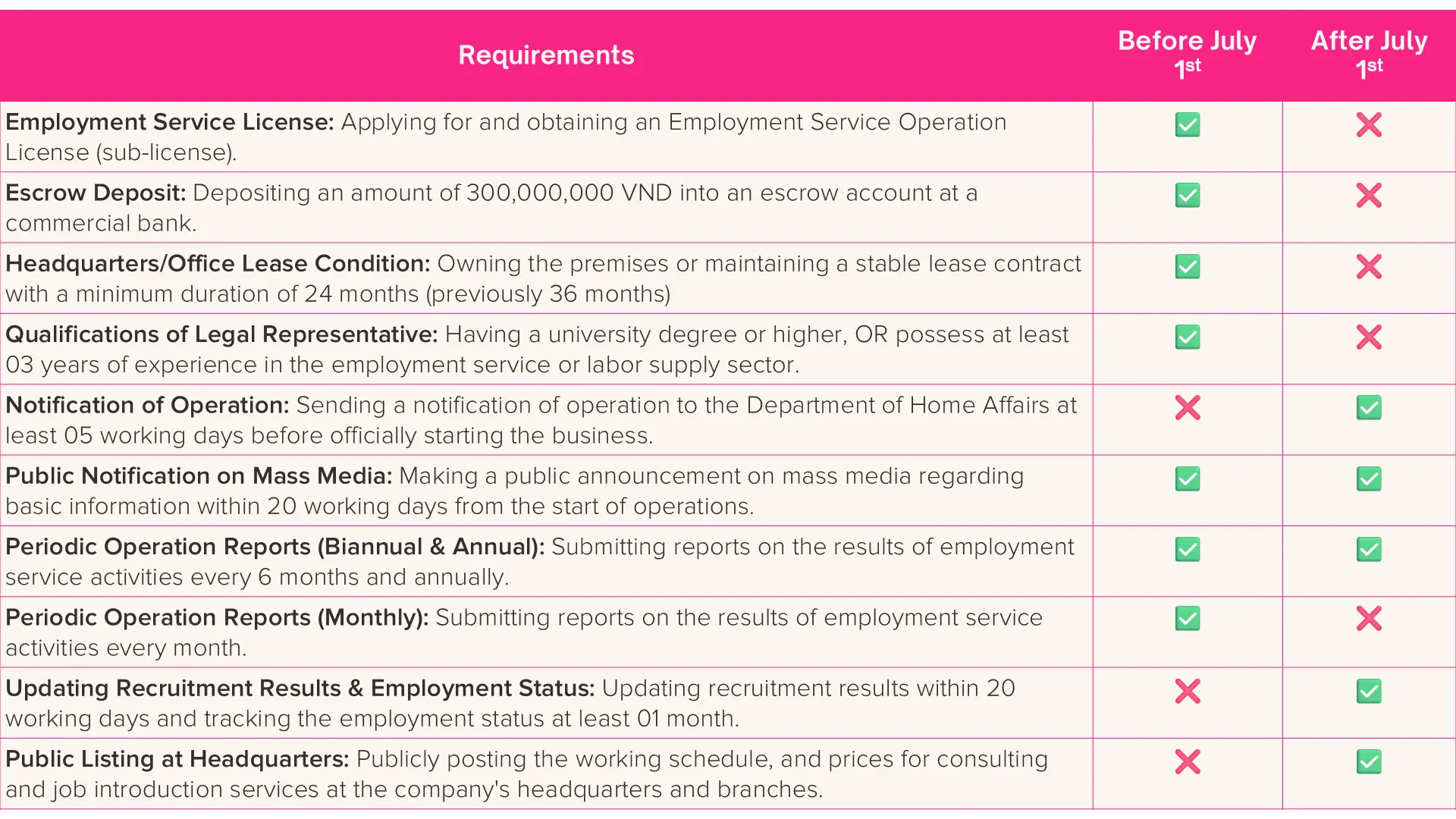
To formally set up a recruitment company in Vietnam in 2026 as a foreign investor, you will follow these five streamlined steps:
- Obtain the Investment Registration Certificate (IRC): As a foreign investor, you must first apply for an IRC. This document approves your investment project in Vietnam. You must detail your investment capital, location, and scale.
- Obtain the Business Registration Certificate (BRC): This is the actual incorporation of your company. You must register the correct Vietnam Standard Industrial Classification (VSIC) codes. For recruitment, headhunting, and staffing, the primary codes are 7810 (Activities of employment placement agencies), 7820 (Temporary employment agency activities), and 7830 (Other human resources provision).
- Post-operating Procedures: Once the BRC is issued, your company exists legally. You will proceed to carve your corporate seal, open your capital and current bank accounts, and register your initial tax information with the local tax department.
- Notification of Operation: Because the pre-approval license is gone, you must formally notify the local Department of Home Affairs (or the designated labor authority) regarding your business location, representative, and contact details via the National Employment Portal at least 5 days before your first day of operation.
- Public Media Announcement: Within 20 working days from the start of operations, your enterprise must publicly announce on mass media basic information such as the business location, field of operations, name of the legal representative, website, email, and contact phone number.
Furthermore, once operational, recruitment agencies must strictly observe specific statutory timelines for structural and operational changes:
- Branch Establishment: Within 10 working days from the date of the decision assigning tasks to the branch, the enterprise must notify both the Department of Home Affairs where the head office is located and the Department of Home Affairs where the branch is located.
- Branch Relocation: A written notice must be sent to the Department of Home Affairs at the branch’s location at least 10 working days before the actual relocation takes place.
- Termination of Operations: The enterprise must notify the Department of Home Affairs at least 5 working days before ceasing operations. Additionally, within 15 working days from the termination date, the enterprise must liquidate all ongoing service contracts and fulfill all associated obligations.
Ongoing Compliance & Authorities Inspection Readiness
The elimination of the setup license is not a free pass to operate without oversight. Vietnam’s employment service requirements have shifted from a sub-license application to an operational check. When an inspection team arrives at your office, your operational actions and your documented proofs will be evaluated together.
To survive sudden audits and avoid heavy administrative fines, your firm must maintain a comprehensive portfolio of compliance documents covering the following operational requirements, but not limited to:
- Corporate Licenses & Personnel Legitimacy:
- Requirement: Your foundational business operations and staff must be legally authorized.
- Required Documents: Valid enterprise certificates (Business Registration Certificate, Investment Registration Certificate), and valid Work Permits for any foreign employees.
- Mandatory Reporting on the Employment Exchange Portal:
- Requirement: You must actively report your business activities to the national system.
- Required Documents: Proof of successful submission for your Bi-annual Report (due before June 20th), Annual Report (due before December 20th), and any event-driven reports as they arise.
- Event-Driven Notifications & Public Transparency:
- Requirement: The government and the public must be kept informed of your operational status and service terms.
- Required Documents: Proof of pre-operation notice submitted within 05 working days before starting operations.
- Proof of notification submitted within 10 working days before officially relocating your branch/headquarters.
- Evidence of a public media announcement published within 20 working days from your operational start date.
- Physical evidence that your working hours and pricing for consulting/placement services are publicly and clearly displayed at your headquarters.
- Timely Recruitment Status Updates:
- Requirement: The government strictly monitors the labor market’s real-time dynamics.
- Required Documents: Evidence that within 20 working days from issuing any recruitment notice, your enterprise has successfully updated the candidate’s status and placement results on the Employment Exchange portal.
- Data Security and Privacy:
- Requirement: Headhunting agencies handle vast amounts of sensitive personal data. You are strictly required to ensure the safety and confidentiality of this information under Vietnam’s tightened privacy laws.
- Required Documents: Demonstrable protocols and internal compliance frameworks ensuring the strict confidentiality of personal data, labor data, and employment transaction records.
Strategic Actions and Impact Analysis for Foreign Investors
So, knowing these changes, what should your immediate business strategy be?
For New Investors Entering the Market: If your timeline allows, we strongly advise holding off on your final incorporation filings until exactly July 1, 2026. By timing your entry perfectly, you will completely bypass the 300 million VND dead-capital deposit. Furthermore, you will not be forced into signing a rigid 24-month commercial lease just to satisfy the old licensing board, giving your startup much-needed financial agility. Use the time right now to prepare your IRC and BRC dossiers so they are ready to submit the moment the new rules take effect.
For Existing Recruitment Agencies in Vietnam: If you already possess an Recruitment License, the new laws provide an excellent financial benefit: starting July 1, 2026, you are legally entitled to withdraw your 300 million VND deposit from the bank without needing prior written consent from the licensing authority. This frees up immediate cash flow for your operations.
However, existing companies must urgently shift their mindset from “bureaucratic dealing” to “internal compliance.” You must audit your current HR, data privacy, and reporting systems immediately. Ensure your IT infrastructure is capable of connecting with the National Employment Portal and that your candidate tracking protocols are flawless to survive upcoming government audits.
Build Your Business on a Solid Foundation with VNBG
The regulatory overhaul driven by Resolutions 66.17/2026/NQ-CP and 66.18/2026/NQ-CP marks a progressive, business-friendly milestone for Vietnam’s HR sector. By removing the cumbersome sub-license and capital requirements, the government is rolling out the red carpet for foreign expertise. However, the shift to a post-check regulatory environment means that operational excellence and strict compliance are more critical than ever.
At VNBG (Vietnam Business Gateway), we do not view ourselves merely as service providers; we are your dedicated local co-founders. We understand the frustrations global companies face with paperwork and local know-how. That is why we approach business setup with the spirit of a traditional artisan: precise, patient, and committed to perfection.
Whether you are looking to seamlessly set up a company in Vietnam 2026 or need robust, ongoing compliance management to navigate the new compliance requirements, VNBG handles the intricacies of the local legal system. We offer always-free consultations, compliance-first strategies, and cost-effective, one-stop solutions. Let us manage your administrative burdens from day one, so you can focus on what matters most: growing your business and dominating the Vietnamese market.