
Last updated on October 21st, 2026 at 06:42 pm
Circular 38/2026/TT-NHNN, issued by the State Bank of Vietnam on July 31, 2026, and effective August 18, 2026, supersedes Circular 06/2019/TT-NHNN. It governs the opening, operation, and closure of Foreign Investment Capital Accounts (FICA) for direct investment in Vietnam. Key reforms include authorizing project enterprises to open a FICA before receiving an Investment Registration Certificate (IRC), allowing advance capital wire transfers prior to corporate registration of capital increases, and making foreign currency accounts optional for pure VND investors. However, the Circular strictly regulates fund usage prior to licensing, mandates account closure when foreign ownership drops to 50% or below, and requires precise wire documentation to comply with anti-money laundering controls.
1. The Evolution of Vietnam’s Capital Account Framework
Managing cross-border capital flows into Vietnam has historically required balancing business speed against strict foreign exchange regulations. Under the Ordinance on Foreign Exchange and the Law on Investment, all legitimate capital injections, foreign shareholder loans, and offshore profit repatriations must pass through dedicated bank accounts overseen by the State Bank of Vietnam (SBV).
For seven years, the old regulation defined this landscape through Direct Investment Capital Accounts (DICA). While that framework stabilized the currency, it created friction for emerging investment models. In response to modern financing practices, the SBV issued a new regulation on July 31, 2026. Taking effect on August 18, 2026, it modernizes foreign exchange rules and standardizes terms to align directly with the Investment Law.
1.1 Standardizing Terminology and Clarifying Scope
Circular 38 introduces precise statutory definitions that eliminate long-standing ambiguities between commercial banks and tax authorities:
- From DICA to FICA: The former term ‘Direct Investment Capital Account’ (DICA) is standardized as ‘Foreign Investment Capital Account in Vietnam’ (FICA). This account functions as the exclusive regulated portal for direct investment equity, medium- and long-term foreign loans, and dividend repatriations.
- Harmonized Legal Concepts: The document replaces the word ‘enterprise’ with ‘economic organization’ and updates ‘Vietnamese investor’ to ‘domestic investor’ to match Investment Law.
- Expanded Coverage: The regulation covers entities operating in International Financial Centers, foreign contractors executing national oil and gas contracts, and Public-Private Partnership (PPP) projects where investors do not form a separate project enterprise.
Distinguishing between a FICA and a standard Current Bank Account remains essential. Operating accounts handle daily commercial revenue, local supplier payments, and domestic payroll. Capital accounts handle equity contributions, foreign debt, and offshore dividend distributions.
2. Core Breakthroughs – What Foreign Investors Gain?
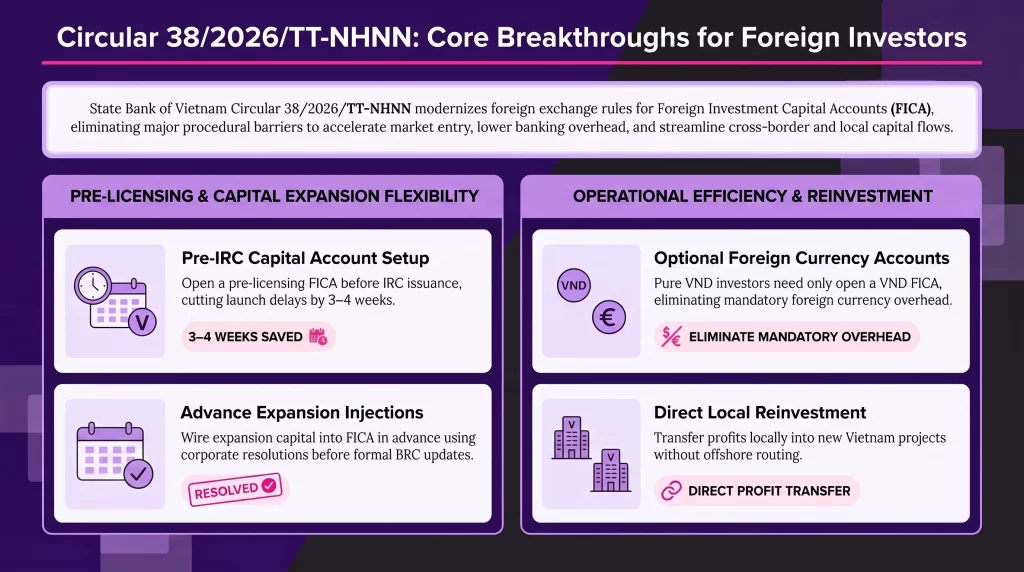
Circular 38 dismantles four significant procedural barriers that previously delayed foreign venture launches by up to four weeks.
2.1 Opening Capital Accounts Prior to IRC Issuance
Under the superseded old rule, commercial banks could not open a capital account until an investor produced both an Investment Registration Certificate (IRC) and an Business Registration Certificate (BRC). This restriction forced early-stage founders to remit funds to personal accounts or third-party intermediaries to cover office leases, hiring deposits, and legal fees. These informal transfers frequently failed downstream tax audits and could not be credited toward statutory charter capital.
The new regulation resolves this problem. An economic entity established prior to the issuance or adjustment of its IRC is legally permitted to open one FICA in foreign currency and/or one FICA in VND at an authorized commercial bank. During this pre-licensing stage, account inflows and outflows are restricted to four statutory purposes:
- Charter Capital Receipts: Receiving charter capital remitted by foreign investors or offshore corporate parents.
- Interest Income: Accumulating bank interest generated by balances on the account.
- Authorized Setup Payments: Disbursing legitimate expenses directly related to investment preparation activities within Vietnam.
- Capital Repatriation Guarantee: Refunding unspent capital offshore if the project is denied an IRC or if founders terminate early setup.
After the IRC is issued or amended, the bank transitions the account into standard operational status without requiring closure or new account applications.
2.2 Advance Capital Injections for Capital Increases
Expanding a business previously required waiting for the Department of Finance (DoF) to issue an amended BRC or IRC before the bank could accept expansion funding. This sequence created delays when companies needed immediate liquidity to purchase equipment or secure industrial leases.
Circular 38 allows investors to wire expansion funds into the foreign investment capital account in advance. Commercial banks credit these funds upon receiving valid documentation such as shareholder resolutions, capital increase agreements, or preliminary filings. Once corporate registration concludes, the company provides the amended BRC to finalize bank records.
2.3 Elimination of Mandatory Foreign Currency Accounts
Circular 06/2019 mandated that every FDI business maintain a foreign currency DICA alongside any VND capital account, even if all capital injections and revenues were denominated entirely in VND. This created unnecessary banking fees and administrative reporting overhead.
Circular 38 removes this requirement. If an FDI enterprise contributes capital and conducts operations solely in Vietnamese Dong, it is required to open only a VND-denominated foreign investment capital account. Foreign currency accounts remain completely optional.
2.4 Flexible Local Reinvestment of Capital and Profits
Previously, offshore investors had limited flexibility when divesting or earning profits from a project in Vietnam. They often had to wire the proceeds abroad before bringing them back to fund a second venture.
Circular 38 allows foreign investors to transfer legitimate after-tax profits, capital transfer proceeds, or liquidated project funds directly from their FICA to their domestic payment account. From there, funds can be deployed into new investment projects across Vietnam without leaving the domestic banking system.
3. What are the key differences of the new Decree?
The following comparative matrix illustrates the structural changes introduced by Circular 38/2026/TT-NHNN:
| Regulatory Dimension | Old Framework (Circular 06/2019) | New Framework (Circular 38/2026) | Practical Business Impact |
| Statutory Account Name | Direct Investment Capital Account (DICA). | Foreign Investment Capital Account in Vietnam (FICA). | Aligns bank nomenclature with the Law on Investment. |
| Pre-Licensing Account Setup | Prohibited; accounts opened only post-IRC and post-BRC issuance. | Allows 1 foreign exchange and/or 1 VND account before IRC. | Enables legitimate pre-incorporation disbursements; cuts 3-4 weeks. |
| Advance Inflows for Capital Hikes | Restricted; banks required amended BRC/IRC prior to crediting funds. | Explicitly permitted based on corporate resolutions and agreements. | Accelerates capital deployment for corporate expansions and upgrades. |
| Foreign Currency Account Mandate | Mandatory dual-currency structure (foreign exchange account required). | Optional; pure VND investors need only open a VND FICA. | Saves annual maintenance fees; removes exchange rate reconciliation friction. |
| Reinvestment Flow Mechanism | Rigid; proceeds commonly required repatriation before re-entry. | Direct transfer from FICA to payment account for other VN projects. | Enables rapid internal capital allocation across local subsidiaries. |
| Threshold for Account Maintenance | Ambiguous enforcement for non-majority foreign holdings. | Strict 50% foreign ownership line; mandatory closure if <= 50%. | Provides clear legal triggers for banking transitions and compliance. |
4. Compliance Risks & Mandatory Account Closure Triggers
While Circular 38 offers operational flexibility, it tightens monitoring of transaction purposes and establishes clear statutory triggers for account closure.
4.1 The 4 Statutory Scenarios Requiring FICA Closure
Under Circular 38, commercial banks must close a foreign investment capital account when any of the following four conditions occur:
- Scenario 1: Cessation or Dilution of Foreign Ownership: When foreign investors transfer 100% of their equity to domestic investors, or when corporate restructuring reduces total foreign ownership to 50% or below. The enterprise must liquidate its FICA and transition ordinary operations to a standard current account within a 12-month grace period ending August 18, 2027.
- Scenario 2: Project Licensing Rejection: When an enterprise establishes a preliminary pre-IRC account but its application is formally rejected by investment authorities, or founders abandon the project. Any unspent capital must be refunded to the offshore investor before account closure.
- Scenario 3: Corporate Dissolution or Bankruptcy: When a foreign-invested enterprise enters formal dissolution, terminates its investment project, or receives a court bankruptcy ruling.
- Scenario 4: Project Transfer Involving Entity Change: When an investment project is transferred in full to a new legal entity, requiring capital operations to move to the new entity’s account.
4.2 Cash Flow Transparency and Wire Purpose Obligations
A common cause of cross-border wire delays is incomplete payment details. Under Circular 38, commercial banks must reject transfers that contain generic wire codes or vague descriptions like ‘operating funds’ or ‘consulting fees’.
Every incoming transfer to a foreign investment capital account must state its explicit statutory purpose.
Examples.
Include ‘Equity capital injection for Project X pursuant to Investment Decision dated DD/MM/YYYY’ or ‘Disbursement of foreign loan under SBV Registration Notice No. YYY’
Commercial banks require verified supporting documents within designated regulatory time-frames following licensing changes.
| Note: Ensure all cross-border SWIFT instructions match the exact statutory wording approved by your custodian bank. Misstated wire descriptions/content can cause incoming transfers to be rejected or frozen during anti-money laundering (AML) audits. |
5. How to Open and Operate a FICA Account in Vietnam?
To set up and run a FICA efficiently under Circular 38, corporate finance teams should follow this 5-step operational workflow:
Step 1: Select an Authorized Commercial Bank
Select a commercial bank licensed by the SBV to perform foreign exchange operations in Vietnam. International banks (such as HSBC, Standard Chartered, or UOB) and tier-one domestic institutions (such as Vietcombank, Techcombank, or BIDV) provide dedicated foreign direct investment desks familiar with Circular 38 pre-IRC on-boarding.
Step 2: Assemble the Pre-Licensing Account Dossier
Submit the preliminary account opening package under Article 7. Required records typically include certified copies of foreign investor passports or corporate registry certificates (authenticated via the Hague Apostille Convention), the enterprise lease agreement, shareholder resolutions appointing the legal representative, and a formal declaration specifying the pre-incorporation budget.
Step 3: Execute Capital Inflow with Precise SWIFT Narrative
Instruct your offshore bank to execute the wire using the exact SWIFT message structure and narrative required by your Vietnamese banking partner. Ensure the ordering customer name matches the investor’s legal entity on corporate filings, and explicitly cite the investment agreement.
Step 4: Convert Pre-Incorporation Funds Post-Licensing
Upon securing the formal IRC and Business Registration Certificate (BRC), provide certified true copies to your bank within 30 days. The bank updates its customer profile and reconciles early operational expenditures directly against statutory charter capital obligations.
Step 5: Manage Operational Inflows and Offshore Repatriation
Maintain clean operational accounting. To remit after-tax dividends offshore at fiscal year-end, submit your audited financial statements and written confirmation from local tax authorities verifying that all corporate income tax (CIT) and withholding obligations have been satisfied.
6. Common Pitfalls to Avoid in Foreign Capital Management
FDI companies often encounter administrative hurdles in capital management due to preventable compliance mistakes:
- Pitfall 1: Missing the Statutory 90-Day Capital Deadline: The Law on Enterprises mandates that investors inject 100% of their committed charter capital within 90 days of BRC issuance. Missing this deadline triggers administrative fines, creates capital reduction liabilities, and can block work permit applications for foreign executives.
- Pitfall 2: Third-Party Capital Remittances: Wiring funds from personal bank accounts of executives, holding company affiliates, or third parties not officially named on the IRC or corporate charter. Vietnamese commercial banks will reject these transfers and return funds offshore.
- Pitfall 3: Receiving Foreign Loans into Current Accounts: Receiving foreign medium- or long-term shareholder loans into a general current operating account rather than the designated FICA, or failing to register qualifying foreign loans with the SBV.
- Pitfall 4: Neglecting the 50% Ownership Transition Rule: Failing to close the FICA within the 12-month transition window (before August 18, 2027) after a foreign ownership transfer drops overseas holdings to 50% or below.
7. How VNBG Protects Your Banking Operations
Managing banking compliance under Circular 38 requires close coordination between international finance teams and local regulatory authorities. A paperwork discrepancy can freeze project disbursements or complicate offshore profit repatriation.
VNBG provides end-to-end corporate and banking support for foreign-invested enterprises in Vietnam. Our advisory team coordinates with partner banks to structure pre-IRC accounts under Article 7, reviews wire instructions, and guides clients through corporate registration, tax compliance, and auditing.
From corporate incorporation and foreign exchange management to ongoing statutory accounting, VNBG serves as your experienced local partner on the ground.