Last updated on October 21st, 2026 at 06:41 pm
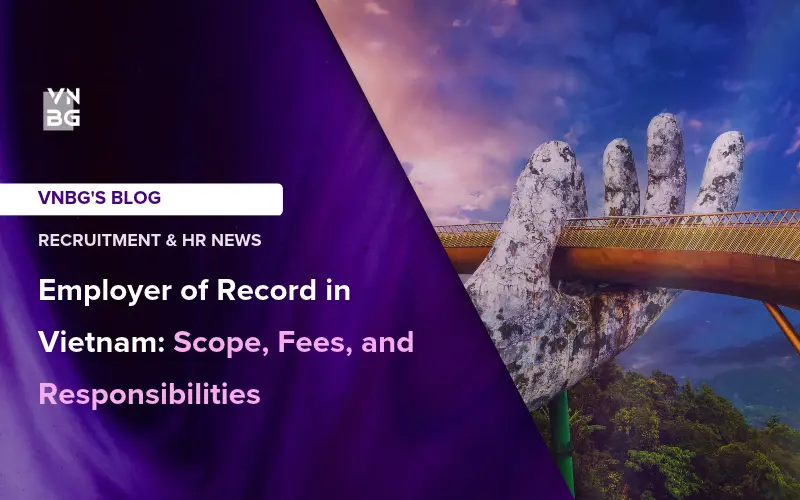
An employer of record in Vietnam (EOR) is a Vietnamese company that legally employs people for a foreign company. With an EOR service in Vietnam, you can hire employees without a company in Vietnam. The EOR signs the labor contract and pays the salary, the taxes, and the social insurance. You manage the daily work of the employees.
This article is for foreign companies and investors who plan to hire in Vietnam. It tells you how the service operates, which problems to find in a provider before you sign, and how VNBG does the work. VNBG started its EOR service in 2018.
Summary
These six facts answer the most frequent questions about an EOR service in Vietnam:
- An employer of record is a local company that is the legal employer of your employees, while you manage their daily work.
- The responsibilities of the EOR are the labor contract, the payroll, the personal income tax, and the state insurance.
- A company in Vietnam is not necessary to hire employees through an EOR.
- Employer of record fees in Vietnam are a flat fee for each employee or a percentage of the payroll, usually 7% to 10%.
- Many providers ask for a deposit of one month of gross payroll. VNBG has one service plan with a deposit and one without.
- VNBG onboards a new employee in a maximum of 48 hours. The permits (Work Permit and TRC) for a foreign employee take 1.5 to 2 months.
Employer of record definition: what is an EOR?
An Employer of Record is a local company that becomes the legal employer of your employees. In Vietnam, the EOR is a Vietnamese company. You select the people, you give them their tasks, and you set their salary.
Employer of record responsibilities in Vietnam
The responsibilities of an employer of record in Vietnam are the legal and administrative parts of the employment:
- Labor contracts and probation contracts
- Monthly payroll, which is the calculation and payment of salaries
- Personal income tax (PIT), the tax on the salary of each employee
- State insurance, which Vietnamese law makes mandatory for labor contracts
The labor contract is between the employee and the EOR. As a result, the EOR is responsible for compliance with Vietnamese labor law. Your company does not sign a labor contract in Vietnam. Instead, your company will sign a service contract with the EOR partner.
What is the difference between an EOR and a PEO?
An EOR and a PEO divide the legal responsibility in different ways. A Professional Employer Organization (PEO) is a co-employer, which means that it shares the employment with your company.
With a PEO, your company stays the legal employer and keeps all liabilities. With an EOR, the EOR is the legal employer and takes the liabilities of the employment.
In Vietnam, many providers use the names PEO and EOR for the same service, and VNBG does too. In the VNBG service, VNBG is the legal employer of your employees in Vietnam. This article uses the name EOR.
Why do companies use an employer of record in Vietnam?
An EOR is the usual solution for a company that wants employees in Vietnam but does not want to open a company there. Vietnam has a large labor force, and the quality of this labor force increases. Employment costs are lower than in adjacent markets. Many foreign companies come to Vietnam for IT professionals. For more information, read How to hire IT professionals in Vietnam.
Companies usually come to an EOR in one of these four situations:
- You have no office or company in Vietnam, and you do not plan to open one.
- You must onboard a new employee quickly.
- You pay a remote team in Vietnam directly from overseas, and the team wants a local labor contract.
- You have a company in Vietnam, but you want a different company to sponsor your foreign employees.
An EOR also gives you local knowledge. The EOR knows the labor market and can give advice on your hiring plan. The EOR can also be the contact between you and your employees in Vietnam.
What must a foreign employer know about employment in Vietnam?
These four facts explain why foreign employers have problems in Vietnam and why a local legal employer solves them.
The labor law protects the employee
Vietnamese labor law gives strong protection to employees. For example, the employer must give a notice of at least one month before the end of an employment. Other legal documents also apply to the labor contract, and they add duties for the employer. An employer who does not know these rules can get a dispute or a penalty. For the details, read What you need to know about employment practices in Vietnam.
State insurance comes only with a local labor contract
Vietnamese law makes state insurance mandatory for labor contracts. A person gets state insurance only when that person has a labor contract with a Vietnamese company. Freelance work does not include it. A remote job that an overseas company pays directly does not include it. This protection is important to many Vietnamese employees. For the details, read Social insurance: why it matters in Vietnam.
Employees expect benefits that are not in the law
Employers in Vietnam usually give benefits that the law does not require. Examples are the 13th-month salary, healthcare, small allowances, team activities, vacation benefits, and lucky money. Lucky money is a cash gift at the Lunar New Year. If you do not give these benefits, your employees can go to a competitor.
Employees want job security
Vietnamese employees give much importance to job security. A job with an overseas employer that has no company in Vietnam looks less safe to them. A labor contract through an EOR makes the remote job a legal full-time job in Vietnam.
How does an EOR service in Vietnam operate? Eight steps
The service has eight steps. Steps 1 to 5 occur one time for each employee. Steps 6 to 8 occur each month.
- Sign the EOR service contract with VNBG.
- Pay the deposit, if your service plan includes one. The deposit is equal to the invoice of one month for each employee. It includes the gross salary, the social security payment of the employer, and the service fee with VAT.
- VNBG adds the employee to the VNBG payroll.
- VNBG prepares the legal documents for the job offer, for example the probation contract and the labor contract.
- VNBG enrolls the employee in the state insurance system, in compliance with the local law and the PIT rules.
- Before the monthly cut-off date, VNBG calculates the salary and the taxes and duties of the employer.
- VNBG sends you one invoice each month. The invoice includes the salary, the benefits, and the expenses of the employee, and the service fee.
- Pay the invoice. On the payday, VNBG pays the employee, and VNBG pays the state insurance and the PIT to the government.
VNBG onboards a new employee in a maximum of 72 hours. For a foreign employee, the permits add time.
Can an employer of record in Vietnam hire foreign employees?
Yes. An EOR in Vietnam can employ foreigners and sponsor their work permits. It is more difficult to employ a foreigner in Vietnam than a Vietnamese citizen. By law, a company must get permits before it hires a foreigner for a job position. This procedure takes 1.5 to 2 months and includes many documents. The company must also send regular reports about its foreign employees to the government.
For this reason, some companies that have their own company in Vietnam use an EOR for their foreign staff. The EOR sponsors the work visa, the work permit, and the temporary residence card (TRC). A TRC is a card that lets a foreigner stay in Vietnam for a long period. EOR providers usually have a different fee for foreign employees.
These two guides give more details about the work permit:
- What you need to know about the work permit in Vietnam
- Work permit: your degree must match your job position
Employer of record fees in Vietnam and five problems to find before you sign
Employer of record fees in Vietnam have two models: a flat fee for each employee, or a percentage of the payroll that is usually 7% to 10%. Some providers add a deposit and VAT on the payroll. EOR providers in Vietnam do not all operate in the same way. These five problems increase your cost or make your hiring slow. Ask each provider about them before you sign.
A deposit of one month of payroll
Many providers ask for a deposit of at least one month of gross payroll before the service starts. The cause is the notice period. The provider is the legal employer, and thus the provider must pay the last month if you stop the employment. The deposit protects the provider, but it locks your capital. For some clients, the deposit is the reason why they refuse the contract.
VAT on the full payroll amount
Value-added tax (VAT) is a tax on the sale of goods and services. Some providers charge VAT on the full amount that you transfer, and this amount includes the gross salary. This occurs when the provider has weak internal procedures or does not have the correct business code on the business certificate for the service. If your team is large or your employees have high salaries, this VAT adds much to your budget.
A fee that is a percentage of the payroll
Some providers take a percentage of the total payroll as their fee. The usual range is 7% to 10%, and some providers ask for 15% to 20%. A percentage fee protects the provider from a loss on high-income positions. For you, the fee changes each time a salary changes. Your budget then becomes more difficult to plan and to approve.
Slow on boarding on paper
Some providers use one week to onboard one employee. They do all the procedures on paper, and they ask for original signatures. Ask the provider how many days the on boarding takes.
Language and culture differences with the provider
Language is the first barrier for most foreign companies in Vietnam. The same barrier can exist between you and your provider. The provider is your contact with your employees and with the local law. If the provider cannot explain the law and the hiring practice clearly, you will not know what occurs in your team. Speak with the consultants of the provider before you sign.
How does the VNBG EOR service in Vietnam compare with common practice?
VNBG has a service plan without a deposit, does not charge VAT on the gross payroll, offers two fee models, and onboards in 48 hours.
| Topic | Common practice in Vietnam | VNBG |
| Deposit | At least one month of gross payroll | Two service plans: one with a deposit and one without a deposit |
| VAT on the gross payroll | Some providers charge it | VNBG only charges VAT on the service fee |
| Service fee | 7% to 10% of the payroll, and 15% to 20% at some providers | Two fee models: a flat fee for each employee, with a discount for more employees, or a percentage of the monthly payroll |
| Onboarding time | One week at some providers | A maximum of 48 hours |
VNBG has two fee models. With the flat fee, the fee for each employee is the same at all salary levels. VNBG gives a discount on the flat fee when you have more employees. With the percentage fee, VNBG calculates the fee as a percentage of the monthly gross salary of the employee. You select the model that agrees with your budget.
VNBG specialists obey service procedures that the company sets and enforces. VNBG manages teams in Vietnam for companies from Japan, Australia, the United Kingdom, the United States, Singapore, and Canada. Consultations about employment law, culture, and HR practice in Vietnam are free.
The VNBG recruitment and EOR service includes these five parts:
- Advice on HR policies and on compensation and benefits (COB) policies for the Vietnam market
- Labor contracts and probation contracts
- Calculation and processing of payroll, tax, and mandatory insurance
- Advice on labor law
- Work visa, work permit, and TRC for foreigners under VNBG sponsorship
How do you manage and keep a remote team in Vietnam?
Remote employees stay when they feel secure in their job. A remote employee is a person who does the work for a company away from the office of that company. More than 75% of VNBG clients came with the same two questions. They asked how to show appreciation to their staff from a distance and how to keep their remote employees.
The companies that keep their teams make the remote job equal to a local full-time job. These four actions help:
- Give each employee a local labor contract through an EOR. The contract brings state insurance and correct tax payments.
- Give the benefits that local employers give, for example the 13th-month salary and healthcare.
- Show appreciation regularly. Plan team activities, and tell the employees when their work is good.
- Use your EOR as a local contact. If an employee has a problem and your company is not in Vietnam, the EOR can speak with the employee.
When employees see no difference from a local job, other employers attract them less. As a result, fewer employees leave.
Frequently asked questions about an employer of record in Vietnam
Is a company in Vietnam necessary to hire employees there?
No. The EOR is the legal employer in Vietnam and signs the labor contract. You manage the daily work of the employee from your country.
What are the employer of record fees in Vietnam?
The monthly invoice includes the salary, the benefits, the taxes and duties of the employer, and the service fee. Providers calculate the service fee as a flat amount for each employee or as a percentage of the payroll. VNBG offers the two models. Contact VNBG for a quotation for your team.
How long does the on boarding take?
VNBG onboards a new employee in a maximum of 48 hours. For a foreign employee, the permits take 1 to 2 months.
Is a deposit necessary?
Many providers in Vietnam ask for a deposit of at least one month of gross payroll. VNBG has two service plans. One plan includes a deposit, and one plan does not. If you do not want to lock your capital, select the plan without a deposit.
Can an EOR sponsor a work permit for a foreigner?
Yes. VNBG sponsors the work visa, the work permit, and the TRC for foreign employees.
What occurs if I stop the employment?
Vietnamese law requires a notice of at least one month before the end of an employment. The EOR is the legal employer and manages the procedure. You pay the employment costs until the end of the notice period.
What to remember about the EOR service in Vietnam
These four points are the most important in this guide:
- An EOR is the legal employer of your employees in Vietnam, and you manage their daily work.
- A company in Vietnam is not necessary to hire employees there.
- Before you sign with a provider, ask about the deposit, the VAT, the fee model, and the on boarding time.
- VNBG has a service plan without a deposit, two fee models, and an on boarding time of 48 hours at most.
VNBG is a one-stop partner for your business in Vietnam
VNBG supplies all the business services that a foreign investor needs in Vietnam. VNBG started in 2018 because foreign companies had the same problems again and again. They did not know the local documents and the local law, and they had no partner in the market. With VNBG, one local team does your legal, tax, HR, and office tasks.
VNBG has four groups of services:
- Business setup: registration of your company in Vietnam
- Business operations: the legal, tax, and HR tasks after the registration
- Recruitment and EOR: hiring, payroll, and legal employment of your team
- Import and export: support for the import, export, and sourcing of goods
Because one partner supplies all these services, you speak with one team about all parts of your business in Vietnam.
Book a free consultation about the EOR service in Vietnam
The consultation with VNBG is always free. In the meeting, tell the consultant how many people you plan to hire, their job positions, and their nationalities. The consultant answers your questions about cost, time, and documents.
After the meeting, VNBG sends you a quotation. You can also ask about company registration, tax, or import and export in the same meeting.