Last updated on October 21st, 2026 at 06:42 pm
Summary
Between August and October 2026, the Vietnamese Government enacted four landmark regulatory frameworks that modernize the operational landscape for foreign direct investment (FDI). Foreign investors can open capital accounts and inject setup funds prior to obtaining an Investment Registration Certificate (IRC). The Hague Apostille Convention took effect on September 11, 2026, eliminating consular legalization for public documents from 125 member countries. Extending the national electronic identification (VNeID) to all lawful foreign residents and forbidding state agencies from demanding paper copies of digitized records. Finally, decentralizing foreign retail licensing to provincial authorities while establishing strict semi-annual compliance audits.
Vietnam’s Accelerated Regulatory Reforms in Q3-Q4/2026
Vietnam’s commercial environment is shifting toward streamlined market access and digitized post-licensing oversight. In previous years, foreign investors faced administrative friction across each stage of their project lifecycle: legalization delays at overseas embassies, rigid foreign exchange controls before corporate licensing, and protracted inter-ministerial evaluations for standard retail establishments.
During the third and fourth quarters of 2026, four foundational legal instruments came into force. These regulations alter how foreign capital enters the country, how cross-border legal documents are validated, how foreign executives verify corporate transactions online, and how foreign-invested companies distribute goods in the domestic market.
| Effective Date | Legal Instrument | Core Domain | Primary Operational Impact |
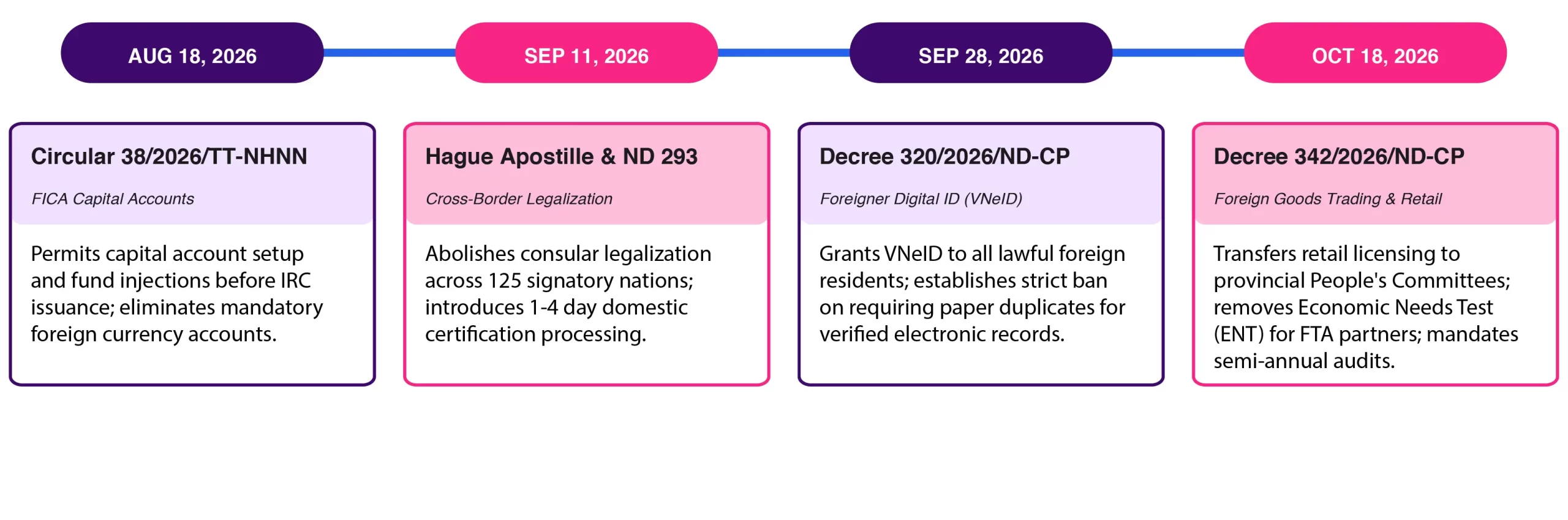
| August 18, 2026 | Circular 38/2026/TT-NHNN | Capital Account (FICA) & Foreign Exchange | Permits capital account setup and fund injections before IRC issuance; eliminates mandatory foreign currency accounts. |
| September 11, 2026 | Hague Apostille Convention & Decree 293/2026/ND-CP | Cross-Border Document Legalization | Abolishes consular legalization across 125 signatory nations; introduces 1-4 day domestic certification processing. |
| September 28, 2026 | Decree 320/2026/ND-CP | Electronic Identification (VNeID) for Foreigners | Grants VNeID to all lawful foreign residents; establishes strict ban on requiring paper duplicates for verified electronic records. |
| October 18, 2026 | Decree 342/2026/ND-CP | Foreign Goods Trading & Retail Outlets | Transfers retail licensing to provincial People’s Committees; removes Economic Needs Test (ENT) for FTA partners; mandates semi-annual audits. |
Table 1.1: The table outlines the implementation schedule and core operational focus of each legal instrument
These four reforms do not operate in isolation. Together, they affect an enterprise throughout its lifecycle: validating legal capacity abroad under the Apostille framework, transferring preliminary funding through Circular 38, authenticating digital administration through VNeID, and securing local trading distribution under Decree 342.
Modernizing Foreign Investment Capital Accounts (FICA)
On July 31, 2026, the State Bank of Vietnam (SBV) issued Circular 38/2026/TT-NHNN, which took effect on August 18, 2026. This Circular completely supersedes Circular 06/2019/TT-NHNN and terminates the amending provisions previously outlined in Circular 03/2025/TT-NHNN. Its primary objective is to align Vietnam’s cross-border banking controls with practical investment schedules.
Pre-Licensing Bank Account Opening and Capital Transfers
Under the previous regime of Circular 06/2019, foreign investors confronted a structural contradiction. Banks could not open a formal Direct Investment Capital Account (DICA) until after the enterprise secured both an Investment Registration Certificate (IRC) and an Enterprise Registration Certificate (ERC). To cover early operational expenses—such as office leases, initial employee deposits, and statutory feasibility fees—founders often wired funds to personal accounts or escrow arrangements. These informal routes triggered compliance audits and caused disputes when converting early spending into recognized equity.
Article 7 of Circular 38 resolves this dilemma. An economic entity established prior to the issuance or amendment of an IRC is now legally authorized to open one Foreign Investment Capital Account (FICA) in foreign currency and/or one FICA in Vietnamese Dong (VND) at an authorized commercial bank. During this preliminary stage, account activity is strictly designated for four lawful purposes:
- Charter Capital Inflow: Receiving charter capital remitted by foreign investors or participating parent members.
- Interest Accrual: Accumulating bank interest derived from credit balances on the capital account.
- Pre-Incorporation Disbursements: Paying legitimate, verifiable expenses tied directly to investment preparation activities within Vietnam.
- Capital Refund Protection: Refunding unspent capital to foreign investors if the project is formally denied an IRC or if project registration fails.
Once the competent investment authority officially issues or amends the IRC, the enterprise does not need to close and re-open banking channels. The existing FICA transitions into an operational direct capital account with zero administrative disruption.
Advance Capital Injections for Capital Increases
Circular 38 also accelerates expansion funding. When an established FDI enterprise plans to expand its scale, investors may now wire funds into the FICA before completing corporate charter capital amendments with the business registration authority. Commercial banks verify the transaction based on corporate resolutions, investment contracts, or initial approval filings, removing weeks of idle waiting.
Optional Foreign Currency Accounts & Expanded Reinvestment Channels
Circular 38 removes the mandatory requirement to maintain dual currency accounts. If a foreign enterprise conducts its capital contributions and operational billing exclusively in VND, it is required to open only a VND-denominated capital account. This cuts redundant account maintenance charges and shields companies from unintended foreign exchange balance discrepancies.
Furthermore, foreign investors who generate legitimate net profits or recover capital from project transfers in Vietnam are no longer forced to wire those funds offshore immediately. The new framework allows investors to transfer balances from the FICA to a standard payment account to fund new domestic ventures or expand sister entities within Vietnam.
The 50% Ownership Rule and Mandatory Account Liquidation
The Circular establishes a clear 50% foreign ownership threshold. Economic organizations with foreign ownership exceeding 50% must maintain an active FICA. When foreign ownership drops to 50% or below, or when foreign shareholders exit entirely, the enterprise must close its FICA and transition ordinary banking to a standard corporate account or an Indirect Investment Capital Account (IICA).
Circular 38 grants a 12-month grace period, running through August 18, 2027, for qualifying enterprises to liquidate their legacy capital accounts. Any charter capital balances sitting in temporary current accounts opened before August 18, 2026, must be consolidated into the designated FICA.
Explore our complete practical manual on banking documentation, currency selection, and step-by-step account liquidation triggers – VNeID for Foreigners & Businesses: New Regulations
The Hague Apostille Convention – Slashing Legalization Red Tape
On December 31, 2025, Vietnam deposited its instrument of accession to the Hague Convention of October 5, 1961, Abolishing the Requirement of Legalisation for Foreign Public Documents (the Apostille Convention). Following the mandatory six-month review period, the Convention formally entered into force for Vietnam on September 11, 2026.
To execute the Convention uniformly, the Government issued Decree 293/2026/ND-CP on July 23, 2026, and the Ministry of Foreign Affairs (MOFA) issued Official Dispatch 7751/BNG-LS on September 3, 2026. These regulations dismantle the traditional multi-tier consular legalization model.
From Two-Step Embassy Legalization to a Single Apostille Certificate
For decades, validating foreign corporate certificates, powers of attorney, board resolutions, or expat credentials required a slow, two-step chain: certification by the originating country’s foreign affairs department, followed by consular legalization at the Vietnamese Embassy or Consulate abroad. This process frequently took three to eight weeks and generated significant third-party courier and agency costs.
Under Decree 293, public documents issued by 125 active member states bearing an authentic Apostille certificate are recognized directly across Vietnam without consular legalization. Vietnamese authorities verify signatures, seals, and issuing capacity directly through electronic registers.
The 3 Critical Objections: Germany, Austria, and the Czech Republic
Corporate legal counsel must note a critical exception under Article 12 of the Convention. Three member states submitted formal declarations of objection to Vietnam’s accession:
- Federal Republic of Germany: Formally objected on May 20, 2026.
- Republic of Austria: Formally objected on June 19, 2026.
- Czech Republic: Formally objected on July 2, 2026.
Due to these formal objections, the Apostille Convention does not apply between Vietnam and these three jurisdictions. Public documents originating in Germany, Austria, or the Czech Republic—as well as Vietnamese documents intended for use in these three countries—must continue through traditional two-step consular legalization. In addition, the Kingdom of Thailand’s accession takes effect on February 28, 2027; documents exchanged with Thailand before that date still require full consular legalization.
Mandatory Certified Vietnamese Translation
A widespread misconception among foreign founders is assuming that an Apostille stamp removes all language requirements. Official Dispatch 7751/BNG-LS clarifies that while the Apostille certificate satisfies authentication, Vietnamese administrative procedure law requires official filings to be submitted in the national language. Therefore, every Apostilled foreign document must still be translated into Vietnamese and officially notarized before presentation to local licensing departments.
Read our comprehensive procedural breakdown covering the 5 covered document groups, regional submission divisions, and online authenticity verification: How to Apply the Hague Apostille Convention in Vietnam.
Digital ID (VNeID) Integration for Foreign Nationals
Issued on August 13, 2026, and effective September 28, 2026, Decree 320/2026/ND-CP amends Decree 69/2024/ND-CP regarding electronic identification and authentication. This decree accelerates digital administration by integrating foreign residents into Vietnam’s National E-ID ecosystem (VNeID).
Relaxed Eligibility Criteria for Foreign Nationals
Previously, foreigners could obtain an e-ID account only if they possessed a Temporary Residence Card (TRC) or Permanent Residence Card (PRC). This excluded short-term foreign representatives, newly arrived technical specialists, and offshore company founders undergoing initial registration.
Decree 320 removes the residence card prerequisite. Any foreign citizen who enters Vietnam lawfully or maintains lawful residence may now register for a VNeID account. Applications are processed through provincial police immigration departments within two business days (if facial biometric and fingerprint data are already recorded) or five business days (if biometric capture is required during application).
The 206 Document Catalog and Paperless Administration
Decree 320 introduces a statutory appendix cataloging 206 types of electronic documents integrated into the VNeID application. This includes 66 categories of individual records (passports, entry visas, diplomas, driving licenses, personal tax codes) and 140 categories of corporate certificates (business registration, fire safety clearances, sector-specific sub-licenses).
Crucially, the Decree establishes a legally binding rule: when handling public administration procedures or commercial transactions, state authorities, commercial banks, and business partners must accept verified digital records stored on VNeID. They are expressly prohibited from requiring citizens or enterprises to present physical original documents or paper copies if that data is active on the system.
Mandatory Digital Integration Deadlines
Decree 320 sets mandatory transition deadlines for digital service providers:
- December 31, 2026: All non-banking electronic transaction systems—including e-commerce marketplaces, social commerce platforms, telecommunications carriers, and electronic invoicing portals—must complete integration and user verification via VNeID.
- June 30, 2027: Commercial banks and non-bank credit institutions must complete full VNeID electronic customer verification (e-KYC) linkage for all financial accounts established prior to September 28, 2026.
[RELATED IN-DEPTH GUIDE] Ensure your corporate legal representatives, foreign specialists, and digital platforms comply before statutory deadlines: review [Decree 320/2026/ND-CP on Foreigner Digital ID (VNeID)](/blog/decree-320-2026-nd-cp-digital-id-vneid-foreigners).
New Regulatory Framework for Foreign Goods Trading
Promulgated on September 3, 2026, Decree 342/2026/ND-CP takes effect on October 18, 2026, completely replacing Decree 09/2018/ND-CP and repealing Article 36 of Decree 146/2025/ND-CP. This text governs export, import, wholesale distribution, retail distribution, and commercial retail outlet establishment for foreign-invested enterprises in Vietnam.
Complete Decentralization to Provincial People’s Committees
Under the previous Decree 09/2018, opening a retail store or securing a business license required provincial departments to send files to the Ministry of Industry and Trade (MOIT) in Hanoi for written appraisal. This inter-tier consultation regularly stretched application timelines to three to six months.
Decree 342 transfers licensing authority directly to provincial People’s Committees. Routine applications for business licenses and retail outlet licenses no longer require MOIT review. Standard retail applications are processed locally within 14 working days.
Targeted National Security Review
Decree 342 replaces general commercial vetting with national security assessments. Under Clause 3, Article 8, inter-agency consultations with the Ministry of Public Security and the Ministry of National Defense are restricted to three specific situations:
- Non-Treaty Foreign Investors: Foreign investors originating from countries or territories that have not executed bilateral or multilateral market access treaties with Vietnam.
- Dominant Digital Platforms: Foreign investors holding direct or indirect control over major digital transaction platforms, e-commerce marketplaces, or commercial social networks.
- Mega-Scale Retail Chains: Retail chains expanding past specific store thresholds: 100 or more outlets under 500 m², 50 or more outlets between 500 m² and 3,000 m², or 30 or more outlets of 3,000 m² and above.
For these three groups, the provincial licensing body refers the dossier to related ministries, which have 14 working days to respond. An objection by either ministry results in a formal rejection. For all other standard retail projects, no central ministry involvement is required.
Slashing Application Burden vs. Strict Post-Licensing Enforcement
Decree 342 abolishes cumbersome financial forecasting and bank capital guarantee certificates. Applicants now provide a practical 5-year business development outline. Furthermore, the term of the Business License is now synchronized with the duration of the Enterprise Registration Certificate (ERC), ending recurrent 5-year renewal cycles.
In exchange for streamlined entry, Decree 342 tightens operational oversight. Enterprises must submit compliance reports twice a year: semi-annual reports by July 15 and annual reports by January 15. The decree introduces severe cancellation clauses: failure to file periodic reports for 24 consecutive months or receiving three administrative fines within a 12-month period results in statutory business license revocation.
Read more: Examine store size thresholds, retail exemption criteria, and the new 5-year business outline model
Comparative Synthesis: What Changed for Foreign Investors?
The shift across these four legal areas transitions Vietnam from bureaucratic pre-approval toward digital administration combined with active post-licensing scrutiny. The matrix below highlights the practical differences between the old rules and the 2026 framework:
| Operational Domain | Legacy Framework (Pre-Q3 2026) | New Framework (2026 Enacted) | Practical Commercial Benefit |
| Cross-Border Paperwork (Legalization) | Mandatory 2-tier embassy legalization; 3-8 weeks turnaround; heavy agent costs. | Single Apostille certificate recognized directly across 125 nations (Decree 293). | Cuts document preparation time by 70-90%; reduces setup and M&A filing friction. |
| FDI Capital Inflow (Banking & FX) | DICA accounts permitted only after IRC & ERC; dual currency accounts mandatory. | Pre-IRC account opening permitted; advance injections for capital hikes; optional VND account. | Accelerates project readiness by 3-4 weeks; eliminates personal account liabilities. |
| Corporate Identity (Administration) | Physical paper filings; foreign representatives required TRC for electronic access. | VNeID granted to all lawful foreign residents; 206 document types digitized; paper copies banned. | Enables rapid digital contract signing, simplified banking e-KYC, and paperless tax filings. |
| Retail & Trading (Market Access) | MOIT central approval required; mandatory financial solvency proofs; annual reporting. | Provincial Committees approval in 14 days; financial proofs abolished; semi-annual reporting. | Eliminates central bottlenecks; shifts corporate focus to ongoing statutory compliance. |
Strategic Action Plan: 4 Priority Steps for FDI Leadership
Corporate executives, CFOs, and general counsel should take concrete steps to adjust internal compliance workflows to match the 2026 framework:
Step 1: Audit Parent Documentation Pipelines
Review your document preparation workflows for upcoming filings. For entities based in any of the 125 active Hague member jurisdictions (such as the US, UK, Singapore, Japan, or South Korea), obtain Apostille certificates directly from domestic authorities and bypass embassy appointments. If your parent entity is in Germany, Austria, or the Czech Republic, maintain traditional consular legalization procedures to prevent administrative rejections in Vietnam.
Step 2: Restructure Banking Protocols Under Circular 38
Coordinate with your authorized custodian bank to establish a FICA before securing an IRC if early disbursements are required for lease contracts or technical consulting. Verify that all wire transfer descriptions state their explicit capital purpose. For established entities expanding operations, utilize advance wire mechanisms before filing charter capital amendments.
Step 3: Enroll Foreign Legal Representatives in VNeID
Assist foreign directors, legal representatives, and key expatriates in obtaining VNeID digital accounts through provincial immigration departments. If your business operates a digital portal or commercial platform, audit backend technical systems to complete user identification integration before the December 31, 2026 deadline.
Step 4: Establish Rigorous Retail Compliance Schedules
For enterprises holding a foreign trading or retail license under Decree 342, add statutory reporting dates to your corporate calendar: July 15 for mid-year data and January 15 for annual figures. Ensure your domestic retail network maintains internal compliance checklists to prevent consecutive administrative violations that could endanger your license.
VNBG Protects Your Operations
While these regulatory updates reduce administrative delays, they also enforce stricter post-licensing scrutiny. Navigating banking rules, foreign document verification, and commercial distribution requires reliable local execution.
VNBG provides end-to-end corporate advisory and administrative services for foreign investors and multinational corporations across Vietnam. Operating as your trusted local partner, VNBG handles corporate incorporation, specialized trading licensing, foreign exchange capital management, certified legal translation, and ongoing tax compliance.
Whether you are planning market entry, adjusting your banking setup to Circular 38, or expanding retail branches under Decree 342, our bilingual advisory team helps protect your corporate standing from day one.
Book a Free Meeting with VNBG
Contact VNBG today to book a free 1-on-1 operational consultation. Our specialists will review your corporate documents, verify Apostille eligibility, coordinate with commercial banks, and safeguard your Vietnam business.