
Last updated on October 21st, 2026 at 03:42 pm
The legal landscape for financial and professional services in Vietnam is undergoing a historic transformation. If you are a foreign investor or an international enterprise looking to expand your footprint to Vietnam, understanding these shifts is critical. On May 15, 2026, the Vietnamese Government officially issued Resolution 66.17/2026/NQ-CP and Resolution 66.18/2026/NQ-CP, marking a profound change in how professional services are governed. Effective from July 1, 2026, through February 28, 2027, these resolutions officially remove accounting services from the list of conditional business lines.
So, why do you need to care about these changes? Previously, foreign investors aiming to setup company in Vietnam within the accounting sector faced high administrative barriers, complex capital ownership restrictions, and lengthy sub-license application processes. The new legal framework dismantles these hurdles, replacing them with a streamlined, fast-track entry system. This means faster market access, lower initial compliance costs, and the ability to operate a 100% foreign-owned accounting firm without the previously required joint-venture restrictions.
In this article, we will explore exactly how these new regulations reshape the landscape of accounting services in Vietnam. We will walk you through the updated establishment procedures, decode the shift from “pre-check” to “post-check” compliance, and provide actionable steps to ensure your firm thrives in this newly liberalized, yet strictly monitored, market.
Key Takeaways
Before we dive into the detailed legal analysis, here are the primary objectives and insights you will extract from this article:
- Complete Deregulation: Understanding the transition of accounting services from a heavily guarded sector to a standard, unconditional business line.
- The End of Mandatory Certificates: Why individuals no longer legally need a Vietnamese Accountant Certificate (APC) or Practice Registration to offer services.
- Streamlined Incorporation: Setup time is slashed from months to just a few weeks. Discover how to incorporate a 100% foreign-owned entity without the burden of corporate sub-licenses, joint-venture restrictions, or mandatory accountant certificates.
- Output-Based Post-Check: Decoding the government’s shift from checking input licenses to auditing the actual quality and legality of your financial reports.
The Major Changes for Accounting Business Operations in Vietnam
What new points in these regulatory documents will change the process of establishing and operating an accounting service company in Vietnam?
The most groundbreaking shift introduced by these 2 Resolutions is the absolute removal of accounting services from the national list of conditional business investments. For decades, the sector was tightly guarded. To provide an accounting service in Vietnam, founders had to prove they met stringent conditions before they could even open their doors—a process legally termed as “pre-check”.
Under the new framework, the government has adopted a modern, business-friendly approach:
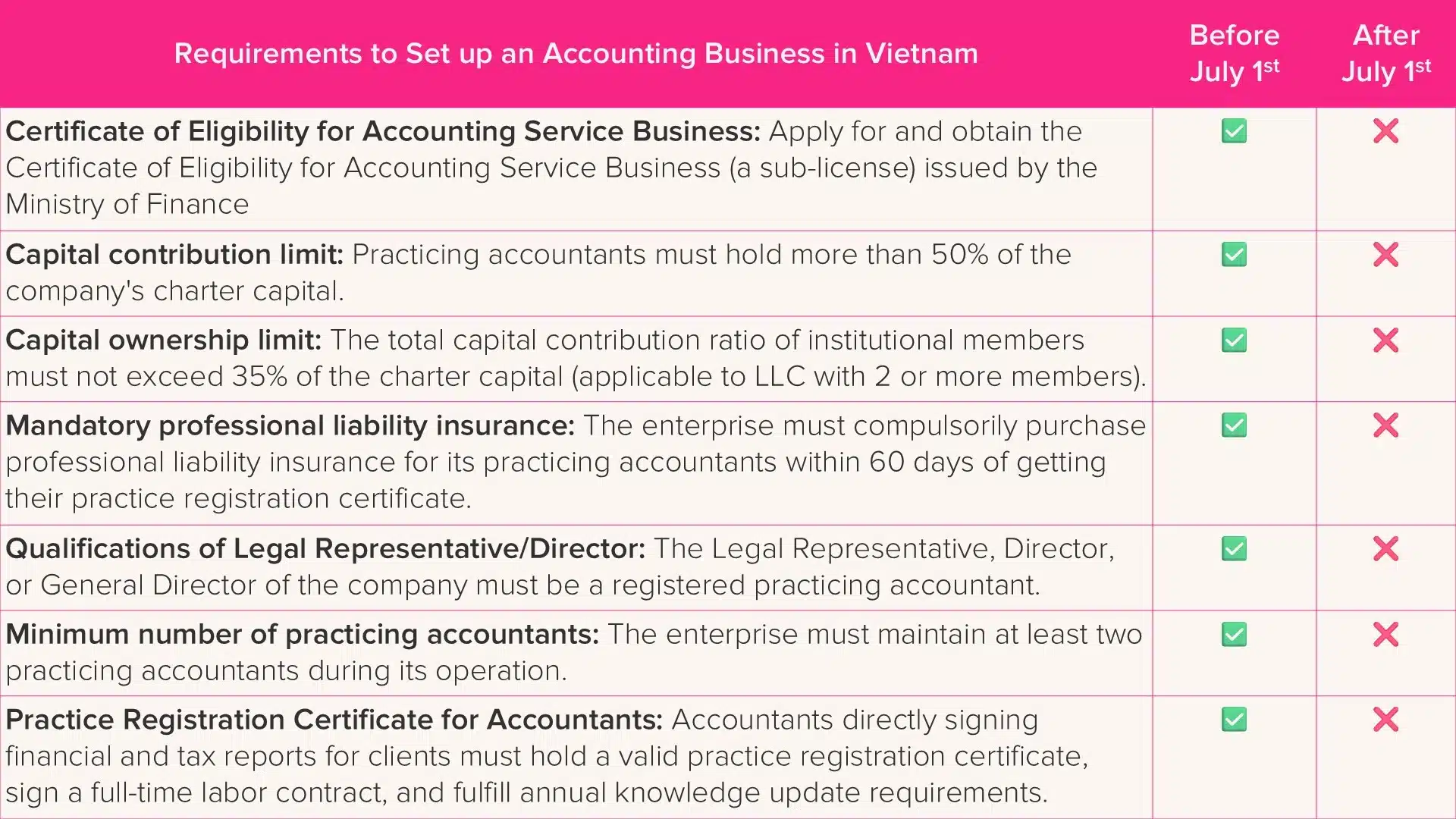
- Abolition of the “Sub-license”: Companies no longer need to apply for the burdensome “Certificate of Eligibility for Provision of Accounting Services” from the Ministry of Finance to register their business.
- Removal of Capital Restrictions: The old rule requiring certified practicing accountants to hold over 50% of the charter capital, and limiting organizational ownership to a maximum of 35%, has been scrapped. Foreign investors can now establish 100% foreign-owned entities much more freely under WTO commitments (CPC 862).
- The Shift to Operational Checking: This is the most crucial concept for foreign investors to grasp. The removal of conditional barriers does not mean the accounting profession is deregulated. Instead, the government has shifted from “pre-check” (demanding proof of qualifications upfront before granting a license) to “post-check” (allowing rapid market entry, but strictly auditing the company’s professional qualifications during active operations).
In essence, the barrier to entry has been lowered to encourage investment, but the standard of professional practice remains exceptionally high and will be heavily audited after you begin operations.
The New Process for Setting Up a Company in Vietnam
What are the steps in the new process of setting up an accounting service company after July 1, 2026?
Prior to these resolutions, founders had to undergo a grueling two-step process: first, obtaining the standard business certificates (Investment Registration Certificate – IRC and Business Registration Certificate – BRC), and second, applying to the Ministry of Finance for a Certificate of Eligibility—a process fraught with delays and paperwork.
After July 1, 2026, setting up a company in Vietnam to provide accounting services follows a highly accelerated, streamlined path. Here is the updated 5-step procedure:
Step 1: Obtain the Investment Registration Certificate (IRC): For foreign investors, the first step is submitting an investment project proposal to the local Department of Finance (DOF). Because the sector is no longer “conditional”, the DOF will evaluate the application based on standard foreign direct investment (FDI) criteria without needing specialized approval from the Ministry of Finance.
Step 2: Obtain the Business Registration Certificate (BRC): Once the IRC is granted, investors register the enterprise. You simply register the business code VSIC 6920 (Accounting, auditing, and tax consulting activities).
Step 3: Post-Licensing Procedures & Tax Registration: Immediately after receiving the BRC, the company must open a corporate bank account, purchase a digital signature token, register for electronic tax filing, and other necessary activities. Capital contribution must be completed within 90 days of the BRC issuance date.
Step 4: Establish Internal Compliance & Professional Setup: While the legal mandate to hire certified Vietnamese CPAs or hold accounting practice certificates has been abolished, establishing strict internal compliance is more critical than ever. Because the government now heavily audits your output (the accuracy of tax and financial reports), your internal setup must focus on hiring competent, experienced staff and deploying robust quality control systems to prevent any risks when delivering the services.
Step 5: Commence Operations under Post-Check Readiness: You can now officially sign service contracts with clients. However, the company must immediately prepare a compliance dossier to be ready for any post-check inspections by the Ministry of Finance or local authorities.
Requirements to Setup an Accounting Business in Vietnam
The End of the Accountant Certificate (APC) Mandate: What You Need to Know
Is it true that individuals no longer need an accountant certificate to do accounting services?
Yes, it is true. This is perhaps the most shocking and significant change about providing the accounting services.
For decades, the Law dictated that anyone signing off on financial reports as a service provider, or acting as the director of an accounting firm, MUST hold an Accountant Certificate (APC) or CPA, and must register their practice with the Ministry of Finance.
As of July 1, 2026, these requirements are officially suspended.
- No More Exams for APC: The Ministry of Finance has stopped organizing exams and issuing new Accountant Certificates (APC). Those wishing to pursue advanced certifications must now aim directly for the Auditor Certificate (CPA).
- No More Practice Registration: The Ministry no longer issues, revokes, or manages the “Certificate of Accounting Practice Registration.”
- Freedom of Appointment: The Legal Representative or Director of an accounting service firm is no longer required by law to be a certified accountant.
Traditionally, the APC was more than just a bureaucratic requirement—it was a state-backed guarantee of a practitioner’s technical competence, ethical standards, and accountability. Without it, how will the government ensure the quality and accuracy of accounting services?
The answer lies in a massive shift of accountability directly from the government to the accounting firm itself. The state no longer acts as a “gatekeeper” regulating who is allowed to sit at the accountant’s desk. Instead, the ultimate responsibility for ensuring correct calculations and strict legal compliance is transferred 100% to your company.
Authorities will now rely on strict post-audit mechanisms to enforce this. Leveraging AI, national e-invoice databases, and interconnected tax systems, the General Department of Taxation will rigorously monitor your firm’s financial outputs. Any errors, discrepancies, or signs of tax evasion will be met with severe financial penalties or criminal liability under the Law on Tax Administration aimed directly at your business.
In short, the state no longer regulates who does the math; it holds your company entirely liable for wrong math.
The Big Question: Should I hire uncertified accountants to serve my clients? With the legal barrier removed, this is the most critical strategic question for firm owners. A neutral evaluation reveals clear trade-offs:
- The Pros (Cost & Flexibility): Expanding your hiring pool to uncertified candidates significantly lowers your payroll and operational costs. It offers immense flexibility, allowing you to hire young, tech-savvy graduates who can be trained to use your firm’s proprietary software and internal processes without demanding premium CPA salaries. You can build a highly scalable, automated workforce.
- The Cons (Liability & Reputation): The absence of formal certification increases the risk of material errors. Because the state no longer holds the individual accountable via a professional license, the ultimate liability falls entirely on your firm. If an uncertified employee miscalculates a client’s tax liability, your firm pays the penalty and suffers the reputational damage. Furthermore, high-value corporate clients may still demand the assurance and prestige of formally certified professionals working on their accounts.
Start Your Business and Stay Compliant with VNBG
The 2 Resolutions represent a watershed moment for the professional services sector in Vietnam. By removing accounting services from the conditional business list, the government has replaced tedious “pre-check” licensing with a dynamic, fast-paced “post-check” environment. While market entry is now faster and capital structuring is more flexible, the burden of maintaining impeccable professional and legal standards has shifted directly onto the shoulders of business owners.
This is where Vietnam Business Gateway (VNBG) steps in. We are not just a service provider; we are your local partner from day one. Designed to bridge the gap between international ambitions and local realities, VNBG specializes in providing one-stop, compliance-first business consulting solutions for foreign investors.
Whether you are looking to swiftly incorporate a new 100% foreign-owned accounting firm, or you need robust business compliance services to safeguard your existing operations against post-check audits, our team of legal, tax, and HR experts is ready to assist. We handle the complexities of local regulations so you can focus on growing your business.
Don’t let post-check compliance hold back your global ambition. Contact VNBG today for a free consultation and let us turn your outside perspective into an inside success in Vietnam.