
Summary
Effective September 28, 2026, Decree 320/2026/ND-CP amends Decree 69/2024/ND-CP and eliminates the primary administrative roadblock for foreign-owned businesses in Vietnam.
- Foreign Legal Representatives no longer need a Temporary Residence Card (TRC) to obtain a VNeID account. Legal entry under any valid visa or e-visa is now sufficient.
- The regulation also replaces the divided Level 1 and Level 2 system with a single unified biometric account issued through Provincial Immigration Offices. This change enables foreign-invested enterprises to activate their Corporate VNeID accounts immediately for electronic tax (eTax) and social insurance (VssID).
- Foreign executives must verify that their mobile SIM cards match their passports before September 28, 2026, to avoid automatic account lockouts.
1. The Administrative Bottleneck: Why Foreign Directors Were Trapped
Since July 2024, Vietnam has migrated all public administrative services to the national electronic identification platform known as VNeID.
Every company operating in Vietnam must use an electronic identification account to submit tax returns, manage customs declarations, and enroll employees in mandatory social health insurance.
However, the previous regulatory framework under Decree 69/2024/ND-CP created an administrative trap for foreign-invested companies.
Decree 69/2024 Bottleneck to register personal VNeID:
Foreign Director Arrives → Needs Work Permit (4-8 weeks) → Needs TRC (2-4 weeks) → e-ID Delayed 90 Days → Corporate eTax & Social Insurance Frozen!
The Chicken-and-Egg Residency Trap
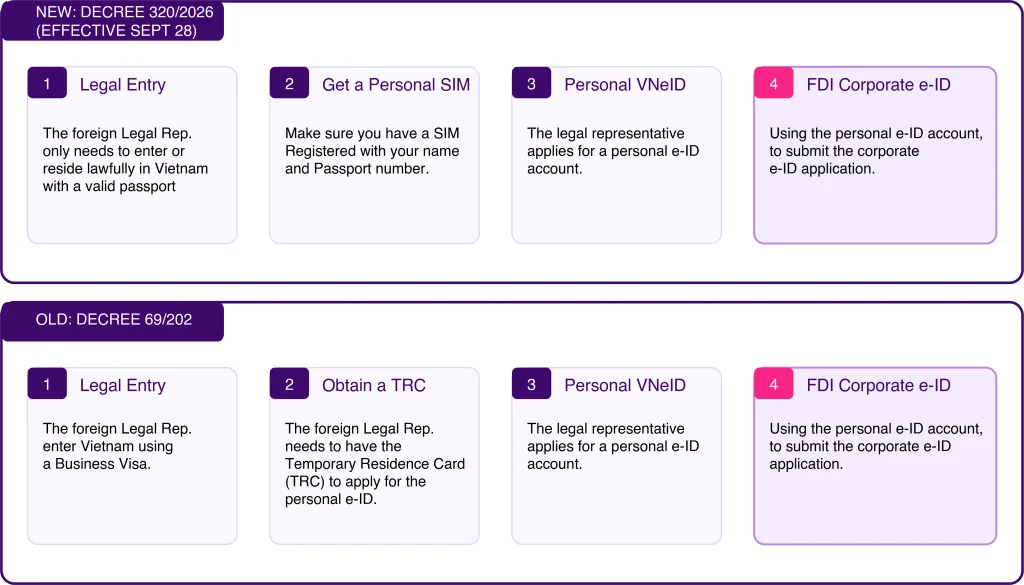
Under Decree 69, a foreigner could only apply for a personal VNeID account if they held a valid Temporary Residence Card (TRC) or Permanent Residence Card (PRC).
This rule created an operational deadlock for newly established companies:
- To obtain a TRC, a foreign director or Legal Representative must first secure an approved Work Permit (or an official Work Permit Exemption certificate) or complete formal capital contribution verification.
- In contrast, Vietnamese tax law requires an enterprise to submit its initial business report and open corporate banking channels within 10 to 30 days of receiving its Business Registration Certificate (BRC).
- Because the electronic tax portal (eTax) and national public service portals require the Legal Representative to authenticate through VNeID, newly established foreign companies found their corporate digital accounts locked.
The Level 1 vs. Level 2 Confusion
Under the old rules, foreign managers often downloaded the VNeID mobile app and completed an initial online verification using their passport details. The system assigned them a “Level 1” account.
The executives believed they had satisfied legal requirements.
However, when corporate accountants attempted to link the director’s personal account to the company’s tax code, government servers rejected the connection.
Under Decree 69, corporate representation strictly required an in-person biometric registration (“Level 2”), which was unavailable to anyone without a physical TRC card.
This miscommunication caused administrative delays and frustration across the international business community.
2. Regulatory Breakthrough: What Decree 320/2026/ND-CP Changes
To resolve these administrative delays and improve the foreign direct investment climate, the Government issued Decree No. 320/2026/ND-CP on August 13, 2026. The decree takes effect on September 28, 2026, introducing major procedural simplifications.
Complete Abolition of the TRC/PRC Precondition
Decree 320 amends Article 7 of Decree 69/2024/ND-CP. The revised rule states that any foreign citizen who enters Vietnam or resides legally in the country is eligible to register for an electronic identification account upon request.
Foreign directors no longer need to wait for Work Permits or physical TRC cards.
A foreign executive entering Vietnam on an ordinary business visa (DN1/DN2), an investor visa (DT), or a standard 90-day electronic visa (e-visa) can register for an electronic identification account immediately.
A Single, Unified e-ID Account
It also eliminates the confusing division between Level 1 and Level 2 accounts for foreigners.
Instead of a two-tier classification, Vietnam now issues a Single Unified Foreign e-ID Account.
Foreign applicants complete an in-person biometric enrollment at a Provincial Police Immigration Office.
The captured data includes digital facial photography and ten electronic fingerprints, linked directly to the national immigration database.
Once approved, this unified account provides full statutory authority. It allows the holder to conduct personal transactions, sign legal filings, and represent corporate entities on state administrative portals.
The Zero-Paper Mandate
Article 2 of Decree 320 establishes an explicit prohibition on physical paperwork when digital records exist.
The system expands the catalog of integrated digital documents on VNeID to 206 document types, including 140 corporate administrative records and 66 personal documents.
State departments, local tax branches, and commercial banks are legally forbidden from demanding physical originals or certified notarized paper copies if the relevant document has been verified on the VNeID database.
This rule reduces courier fees and accelerates corporate administrative filings.
Instant Automated Corporate Linkage
Under the updated technical framework, once a foreign Legal Representative obtains an approved unified account, the VNeID platform connects directly to the National Enterprise Registration Database operated by the Ministry of Finance (MoF).
3. Comparative Breakdown: Decree 69/2024 vs. Decree 320/2026
The table below outlines the regulatory differences between the previous rules and the new framework taking effect on September 28, 2026:
| Evaluation Criteria | Previous Rule | New Rule | Practical Impact on Foreign Companies |
| Eligibility Condition | Foreigner had to hold a physical TRC or PRC card | Any foreigner legally entering or residing in Vietnam (any valid visa or e-visa) | Immediate Access: Foreign directors can complete registration during their initial visit |
| Account Structure | Divided into Level 1 (online only) and Level 2 (biometric) | Single Unified Biometric Account with full legal standing | Simplicity: Eliminates account confusion and rejected corporate links |
| Registration Location | Level 1 via mobile app; Level 2 at Immigration Offices | Provincial Police Immigration Offices | Standardized, secure biometric capture verified against entry records |
| Telecom SIM Verification | Recommended, but manual and inconsistent | Automated and Mandatory: Auto-locks accounts if subscriber details do not match | Critical Risk: SIM cards must be registered under the foreigner’s passport |
| Paper Document Demands | Agencies routinely demanded certified paper copies | Strict Prohibition: Agencies cannot demand paper for 206 digital records | Efficiency: Substantial reduction in notarization, translation, and courier expenses |
4. Step-by-Step Roadmap: Obtaining a Unified Foreign e-ID
To complete registration smoothly under Decree 320, foreign directors and their corporate administrative teams should follow this four-step process.
Step 1: Audit SIM (Text TTTB to 1414), or buy a new SIM
→ Step 2: Prepare Form TK01 & Passport
→ Step 3: Biometrics at Provincial Immigration
→ Step 4: Activate VNeID App & Link Corporate Tax Code
Step 1: Telecom Subscriber Verification (Mandatory Prerequisite)
Before scheduling an appointment with immigration authorities, verify the registration of the foreign executive’s mobile phone number.
The mobile number linked to a VNeID account must be registered under that exact individual’s passport details within the official telecommunications carrier database (Viettel, VNPT, or Mobifone).
If you do not yet have a Vietnamese SIM card, you can purchase one and register your personal details at the same time.
If you already have a SIM card, you can verify/ check your information by following these steps:
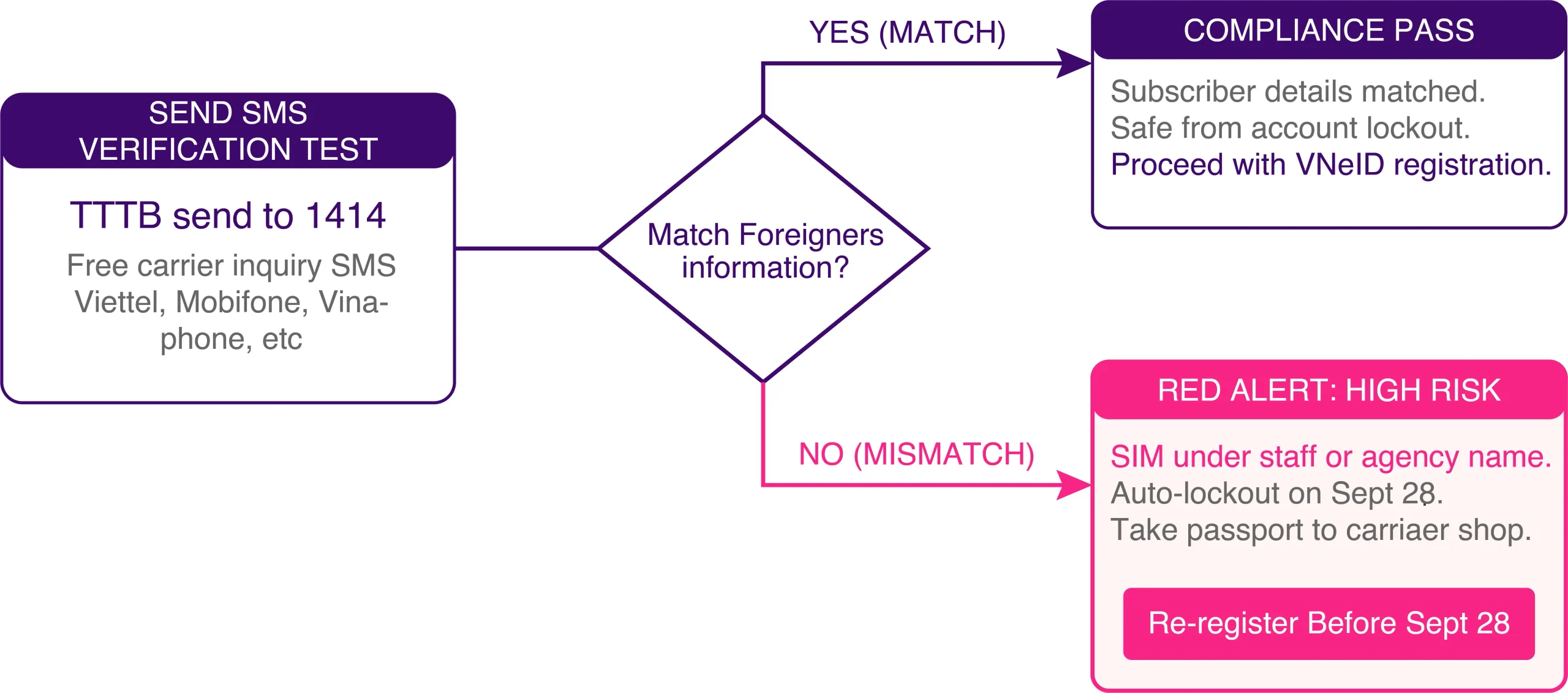
- Verification test: Send a free SMS message with the text TTTB to the national number 1414.
- Review response: The carrier will return the registered subscriber name, date of birth, and identity document number.
- Action on mismatch: If the SIM card is registered under a local employee’s name, a corporate administrative pool, or an external agency, the foreign executive must take their original passport to an official carrier customer center to transfer the subscription into their own name before proceeding.
Step 2: Prepare the Application Dossier
Prepare the following documents for the registration submission:
- Original valid foreign passport: Must have at least six months of remaining validity, along with the current Vietnamese visa, temporary residence stamp, or approved electronic visa slip.
- Completed Application Form TK01: The official registration form for foreign nationals, prepared in accordance with the revised template under Decree 320/2026/ND-CP.
- Active personal email address and verified mobile phone number: Must match the details verified in Step 1.
- Corporate Appointment Documentation: A certified copy of the company’s Business Registration Certificate (BRC) naming the applicant as the Legal Representative, accompanied by the corporate appointment resolution or employment contract.
While statutory frameworks do not explicitly require corporate documents during identity verification for Legal Representatives, local authorities can request organizational proof to validate account creation. Hence, foreign executives are recommended to compile complete corporate documentation for the application dossier.
Step 3: Biometric Enrollment at Immigration Authorities
The foreign director must appear in person at the competent immigration agency:
- Location: The Provincial Police Immigration Office where the foreigner resides or where the company maintains its registered corporate headquarters, or the national Immigration Department in Hanoi or Ho Chi Minh City.
- Biometric collection: Officers will capture a direct digital facial portrait and complete a ten-finger biometric scan. The system validates the data against the National Entry and Exit Database.
- Receipt confirmation: The applicant receives an official paper appointment slip with an application tracking code.
Step 4: System Verification and Application Activation
- Processing timeline: Under standard administrative service standards, applications are processed within 3 to 5 business days.
- Activation notification: The system transmits an automated approval code via SMS to the verified mobile number and via email.
- Mobile app activation: The foreign director downloads the official VNeID mobile application (available on Apple App Store and Google Play Store), selects “Activate Account,” enters their assigned identification code and passport number, and sets up a personal six-digit passcode and biometric face/fingerprint login.
5. Corporate Electronic Identification: Activating and Managing an FDI Account
Once the foreign Legal Representative activates their personal unified account, the enterprise can activate its corporate digital profile.
Linking the Corporate Entity
The activation process follows a direct digital verification:
- The foreign Legal Representative logs into the VNeID mobile application.
- The user navigates to the “Organizational Services” module and selects “Register / Link Enterprise Account.”
- The user inputs the company’s official 10-digit Business Code and other company information.
- The VNeID platform executes an automated cross-check against the National Enterprise Registration Database.
Because the applicant’s name and passport number match the Legal Representative listed on the Enterprise Registration Certificate, the system confirms corporate linkage automatically.
Internal Role-Based Access Control (RBAC) Delegation
A foreign General Director does not need to handle daily administrative filings personally. Decree 320 establishes a secure digital delegation mechanism that replaces the risky habit of sharing login credentials.
The foreign Legal Representative serves as the Master Account Administrator.
From the administrative dashboard, the director can assign specific procedural roles to internal staff:
- Chief Accountant / Finance Team: Delegated access strictly limited to the General Department of Taxation portal (eTax) for quarterly VAT filings, CIT estimates, foreign contractor tax remittances, and electronic invoice generation.
- Human Resources Manager: Delegated access strictly limited to the Vietnam Social Security portal (VssID) for monthly labor declarations, insurance adjustments, and maternity/sick leave benefit processing.
- Legal and Operations Staff: Delegated access for online work permit renewals through provincial labor departments and customs clearance verifications.
Each employee logs into state portals using their own personal VNeID credentials.
The system records an immutable audit log of all corporate transactions. If an employee resigns, the Legal Representative can revoke that person’s operational delegation within seconds, protecting corporate security.
6. Critical Red Alert: The Mandatory SIM Matching Rule
The most urgent operational risk in Decree 320/2026/ND-CP is the mandatory telecommunications data synchronization that takes effect on September 28, 2026.
The Automated Lockout Mechanism
Starting September 28, 2026, the system runs automated data audits.
If an active VNeID account is linked to a mobile phone number whose telecommunications subscriber record does not match the account holder’s full legal name and passport number, the system will lock the VNeID account automatically without prior manual warning.
The Expat SIM Hazard
In practical operations across Vietnam, foreign executives rarely purchase and register SIM cards personally.
Many foreign managers use mobile phone numbers that were:
- Purchased informally by company administrative assistants.
- Registered under a local human resources officer’s Vietnamese National Identity Card for convenience.
- Bundled under an old corporate telecommunications package without individual subscriber names.
Under Decree 69, this discrepancy caused occasional verification issues. Under Decree 320, it triggers an immediate automatic system lockdown.
SIM Registered Under Local Assistant
→ Auto-Audit on September 28, 2026
→ The Foreign Director’s personal VNeID account will be locked if their personal information is not registered.
→ Corporate VNeID Account Inactive
→ Company Cannot Authorize eTax Payments or Payroll Banking!
If the foreign Legal Representative’s personal account is locked, the company’s Corporate VNeID profile freezes immediately. The company will be unable to approve tax filings, authenticate online bank transfers, or submit monthly social insurance declarations.
Perform the TTTB to 1414 subscriber audit immediately for all foreign board members and executives.
7. Unblocking Core FDI Functions
VNeID serves as the primary authentication and single sign-on (SSO) credential required to log into various official government public service portals.
Unblocking the electronic identification bottleneck allows foreign-invested enterprises to rapidly activate their corporate VNeID accounts. Ensuring continuity across the following administrative and compliance operations:
Electronic Tax Management (eTax / Thuedientu)
Companies must access the General Department of Taxation’s electronic portal (thuedientu.gdt.gov.vn) to maintain corporate tax compliance:
- Submitting quarterly Value-Added Tax (VAT) and provisional Corporate Income Tax (CIT) filings.
- Generating and issuing statutory electronic invoices (e-invoices) for domestic sales.
- Paying Foreign Contractor Tax (FCT) on cross-border software licenses and offshore technical consulting.
- Verifying tax clearance status for corporate profit repatriation.
Social Security Administration (VssID / Vietnam Social Security)
Vietnamese law imposes strict deadlines on statutory labor reporting:
- Filing monthly social, health, and unemployment insurance contributions for local employees.
- Enrolling qualified foreign employees in mandatory social insurance schemes.
- Disbursing sick leave, maternity compensation, and statutory medical insurance cards.
- Avoiding administrative late-payment interest charges, which compound automatically under social security audits.
Online Work Permit Processing (Ministry of Home Affairs / DOLISA Portals)
Provincial labor departments have transitioned foreign workforce management to digital public service portals:
- Submitting foreign labor demand explanation reports
- Applying for new Work Permits and Work Permit renewals.
- Filing applications for Work Permit Exemption certificates for foreign investors and intra-company transferees.
Customs Declarations & Corporate Amendments
- Authenticating electronic digital signatures on the VNACCS/VCIS national customs database for import and export shipments.
- Submitting digital dossiers for business license amendments, capital increases, and registered address changes to provincial departments of planning and investment.
8. Action Checklist Before September 28, 2026
To prepare your company for the enforcement of Decree 320/2026/ND-CP, complete this five-step compliance checklist:
- Audit Executive Mobile Subscriptions: Have all foreign directors text TTTB to 1414. If the registered information does not match their passport, visit a carrier store immediately to update subscriber ownership.
- Verify Immigration Entry Documents: Ensure your foreign Legal Representative holds an active passport with at least six months of validity and a valid Vietnamese visa, entry stamp, or electronic visa.
- Prepare Registration Dossiers: Complete Application Form TK01 and compile corporate appointment resolutions and Enterprise Registration Certificates.
- Complete Biometric Enrollment: Schedule and attend the in-person biometric appointment at the competent Provincial Police Immigration Office.
- Activate Corporate Linkage and Role Delegation: Link your enterprise tax code on the VNeID platform and configure operational access permissions for your internal finance and human resources managers.
9. Partner with VNBG
VNBG acts as your one-stop solutions partner in Vietnam. Since 2018, we have guided more than 300 international corporations, technology firms, and foreign investors through business setup, tax and accounting, bookkeeping, recruitment, trading services, and statutory compliance.
Our experience services team manages the entire Decree 320 compliance process:
- Auditing executive telecommunications records to eliminate SIM lockout risks.
- Preparing and verifying Application Form TK01 and corporate linkage documentation.
- Providing bilingual legal specialists to escort foreign executives in person to Provincial Immigration Offices for expedited biometric enrollment.
- Activating corporate VNeID accounts and configuring customized Role-Based Access Control (RBAC) matrices for your internal accounting and HR teams.
- Resolving portal access errors on eTax, VssID, and national public service systems.
Do not let telecommunications discrepancies or administrative delays interrupt your corporate operations.
10. Book a free consultation with VNBG
Contact VNBG today to secure your company’s digital compliance.
- Related Compliance Resources:
- Learn more about work permit application and renewal in Vietnam.
- Understand your electronic tax filing obligations for foreign businesses.
- Review the legal responsibilities of foreign legal representatives in Vietnam.
- Ensure compliance for CIT finalization and eTax compliance.
- Official Regulatory Portals: