Last updated on October 21st, 2026 at 06:41 pm
Summary
Foreign Contractor Tax (FCT) in Vietnam applies to foreign companies and foreign individuals that earn income from contracts or services performed in Vietnam without establishing a local legal entity.
FCT is not a standalone tax. It is a withholding mechanism combining Value Added Tax (VAT) and Corporate Income Tax (CIT). The most common payment method is the Direct Withholding Method. Under this method, the Vietnamese buyer withholds between 5% and 10% total tax from invoice payments and remits the funds to the tax bureau before sending the balance abroad. Commercial contracts must clearly state whether prices are Net or Gross to avoid unbudgeted tax expenses.
1. What is Foreign Contractor Tax (FCT) in Vietnam?
Foreign Contractor Tax is the official mechanism that the Vietnamese government uses to collect taxes from foreign businesses that generate revenue inside Vietnam.
When an overseas company provides software licenses, technical consulting, marketing services, or cloud infrastructure to a Vietnamese customer, the overseas company rarely establishes a domestic company in Vietnam. Under ordinary tax systems, that offshore company might escape local taxes because it does not maintain an office in the country. Vietnam addresses this through the Foreign Contractor Tax framework.
FCT is governed by Circular 103/2014/TT-BTC and updated guidelines in Circular 89/2026/TT-BTC and Tax Administration Law 108/2025/QH15.
Many foreign executives assume that FCT is a distinct, third type of corporate tax. It is not. FCT is simply a structured collection process for two existing statutory taxes:
- Value Added Tax (VAT): Collected on the consumption of services or associated goods delivered within Vietnam.
- Corporate Income Tax (CIT): Collected on the income earned by the foreign entity from Vietnamese sources (or Personal Income Tax for individual contractors).
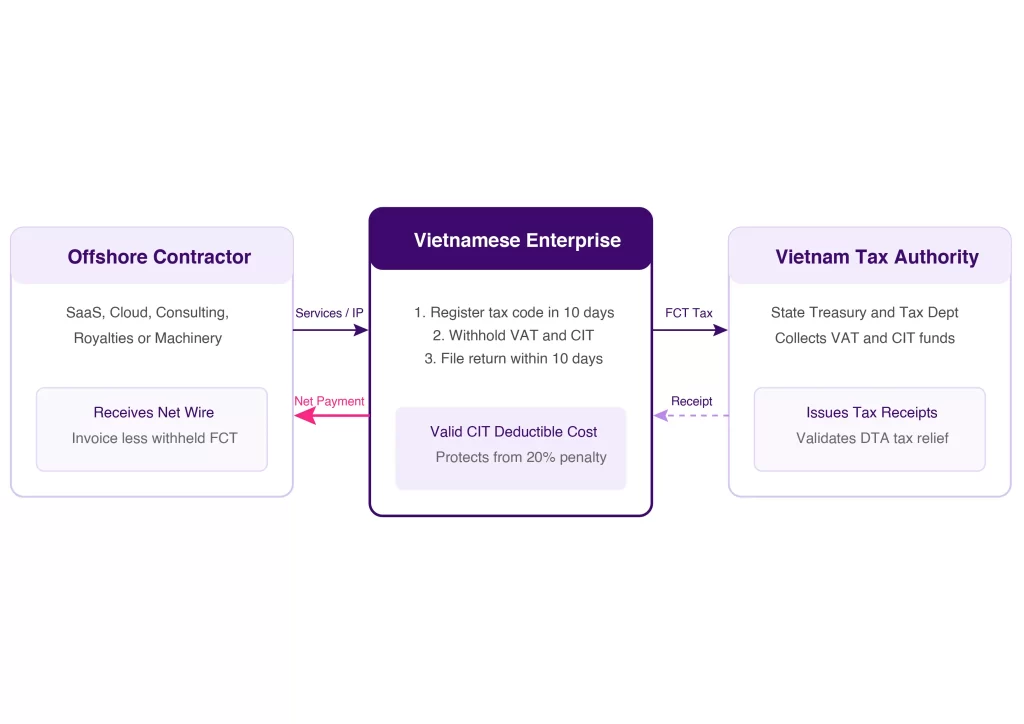
Because foreign vendors do not maintain a local tax presence, the law places the legal and administrative responsibility directly on the Vietnamese customer. The Vietnamese entity acts as the withholding agent. The Vietnamese customer must register a contractor tax code, withhold the correct tax percentage from the vendor’s payment, remit that money to the State Treasury, and file official tax declarations.
2. Who Must Pay FCT (and Who is Exempt)?
Determining whether a transaction triggers FCT requires looking at where the service is performed and where the benefit is consumed.
Transactions Subject to FCT
Under Vietnamese tax rules, FCT applies to the following activities:
- Cross-border digital and cloud services: Software-as-a-Service (SaaS), cloud storage (such as AWS, Azure, Google Cloud), and overseas IT support consumed by Vietnamese businesses.
- Online advertising: Digital advertising delivered to users in Vietnam (such as Meta Ads, Google Ads, and LinkedIn Campaign Manager).
- Professional and management consulting: Legal advice, business consulting, financial advisory, and technical engineering services delivered to a Vietnamese customer.
- Intellectual property and licensing: Trademarks, copyrights, patents, technology transfers, and proprietary software rights.
- Goods delivered with accompanying domestic services: Supply of industrial machinery, manufacturing lines, or medical equipment that includes installation, testing, warranty, or staff training inside Vietnam.
- Offshore financing: Interest payments on foreign commercial loans or shareholder loans paid by Vietnamese companies to offshore lenders.
Transactions Exempt from FCT
The law grants explicit exemptions for transactions where no taxable activity or consumption occurs within Vietnam:
- Pure supply of goods at foreign borders: International sales where goods are delivered outside Vietnam (such as Incoterms FOB or CIF at the port of departure or foreign port) without any local installation, commissioning, or warranty services provided by the seller in Vietnam.
- Services performed and consumed outside Vietnam: Professional services conducted entirely overseas for which the benefit is consumed outside Vietnam. Examples include advertising at an overseas trade expo, equipment repair conducted at an overseas workshop, or training delivered at an overseas campus.
- International transportation: Inbound and outbound cargo shipping where the transport occurs outside Vietnamese territorial borders under specific international agreements.
- International commercial brokerage: Brokerage activities performed strictly outside Vietnam to sell goods or services overseas.
If your cross-border agreement combines the delivery of physical equipment with local engineering services, you must separate the equipment price from the service price on the contract. If you fail to separate the values, the Vietnamese tax authority will apply the higher service tax rate to the entire contract sum.
3. The 3 Methods of Filing and Paying FCT
Vietnam allows three different accounting methods for determining and remitting FCT. The operational realities of your foreign vendor dictate which method is legal and practical.
| Method | Conditions for Application | Accounting System | Filing Responsibility |
| Direct Withholding Method | Most common; applies when the vendor has no local entity and does not maintain VAS | Local buyer maintains ordinary purchase records | Vietnamese buyer withholds and remits tax |
| Deduction Method | Contractor maintains a Permanent Establishment (PE) or branch, stays 183+ days, adopts VAS | Full Vietnamese Accounting System (VAS) required | Foreign contractor files directly with tax authority |
| Hybrid Method | Foreign contractor has a local office, registers for VAT under VAS, but pays CIT on deemed percentage | Simplified VAS accounting for VAT only | Foreign contractor or appointed local tax agent |
Method 1: The Direct Withholding Method (Deemed Method)
The Direct Withholding Method is used in most of cross-border transactions in Vietnam.
Under this method, the foreign contractor does not register for Vietnamese taxes, does not keep Vietnamese accounting books, and does not open a local bank account. Instead, the Vietnamese buyer calculates the tax using statutory “deemed” percentages set by the Ministry of Finance. The buyer deducts the tax directly from the payment and wires the remaining balance to the overseas contractor.
Method 2: The Deduction Method (Declaration Method)
Foreign contractors can only use the Deduction Method if they meet three strict conditions:
- They maintain a Permanent Establishment (PE) or resident tax presence in Vietnam.
- The contract duration is at least 183 days from the effective date.
- They register and follow the full Vietnamese Accounting System (VAS), issue official electronic VAT invoices, and obtain a local tax code.
Under this method, the foreign contractor acts like a domestic business. The contractor files VAT using the input-output credit method and pays Corporate Income Tax at the standard statutory rate of 20% on actual net profit. For most foreign SaaS and consulting providers, maintaining full VAS accounting in Vietnam is too complex and costly for a single project.
Method 3: The Hybrid Method
The Hybrid Method combines elements of the other two approaches. The foreign contractor adopts VAS to declare VAT using the credit method, but chooses to pay CIT based on the statutory deemed revenue percentages. This method is primarily used by large multinational engineering and procurement contractors that operate long-term construction or installation sites in Vietnam.
4. 2026 FCT Withholding Rates by Industry
When you use the Direct Withholding Method, the tax authority sets fixed deemed percentages for VAT and CIT based on the nature of the transaction.
Below is the schedule of deemed withholding tax rates applicable to common commercial sectors under Circular 103/2014/TT-BTC and Circular 89/2026/TT-BTC:
| Business Sector / Activity | Deemed VAT Rate | Deemed CIT Rate | Total Effective Tax Rate |
| General Professional Services (Consulting, legal, marketing, auditing) | 5% | 5% | 10% |
| Online Advertising & Digital Platforms (Meta, Google, automated ad networks) | 5% | 5% | 10% |
| Software Services & IT Maintenance (Bug fixing, custom development, support) | 5% | 5% | 10% |
| Software Licenses & Technology Transfer (Standard licenses, royalties) | Exempt (0%) | 10% (Royalties) or 5% (Licensing) | 5.0% – 10.0% (CIT only) |
| Machinery Supply with Accompanying Services (Installation, testing, training) | 3% | 2% | 5% |
| Construction with Material Supply | 3% | 2% | 5% |
| Construction without Material Supply | 5% | 2% | 7% |
| Offshore Loan Interest (Intercompany or commercial loans) | Exempt (0%) | 5% | 5% (CIT only) |
| International Freight & Transportation | 0% (if meeting conditions as Global Shipping) or 3% | 2% | 2 – 5% |
| Trading of Goods inside Vietnam (Distribution via bonded warehouses) | 1% | 1% | 2% |
Understanding the Software and Royalty Distinction
Software transactions frequently trigger audits because parties confuse software services with software royalties.
Under Vietnamese tax regulations:
- Standard software licenses and software services: These are exempt from VAT under the Law on Value Added Tax. However, they remain subject to 5% CIT under the deemed rate schedule.
- Royalties (payments for IP transfer, source code rights, or brand licensing): These payments are exempt from VAT, but they incur a higher 10% CIT withholding rate.
If your contract bundles software subscriptions with consulting or customization services, write separate line items for the software license and the professional services. If the invoice does not separate these items, tax auditors will levy 5% VAT and 5% CIT on the full contract sum.
5. Net Contract vs. Gross Contract: The Gross-Up Formula
The single most common commercial dispute in cross-border contracting is whether the contract price is “Net” or “Gross.”
Gross Contract: Total Price = $10,000
→ Vietnamese Buyer withholds $975 tax
→ Foreign Vendor receives $9,025 net wire
→ Total cost to Vietnamese Buyer: $10,000
Net Contract: Vendor must receive = $10,000 net wire
→ Vietnamese Buyer must pay tax out of pocket
→ Grossed-up tax base = $11,080.34
→ Total cost to Vietnamese Buyer: $11,080.34 (+10.8% surprise cost)

The Commercial Pricing Reality
- Gross Contract: The stated price includes all taxes. The Vietnamese buyer deducts the FCT amount from the foreign vendor’s invoice before sending the wire. The foreign vendor absorbs the tax cost. The buyer’s total cash outlay matches the contract amount.
- Net Contract: The stated price is net of all Vietnamese taxes. The foreign vendor demands the full invoice amount in their offshore bank account. The Vietnamese buyer must pay the foreign contractor tax out of company funds.
If a contract does not state whether the price is Net or Gross, Vietnamese tax authorities will treat the stated price as Net. This forces the local buyer to pay the tax.
The Gross-Up Mathematical Formulas
When an agreement specifies a Net price, the Vietnamese enterprise must gross up the revenue base so the State Treasury collects its full statutory percentage.
The gross-up calculation follows two sequential steps:
Step 1: Calculate Taxable Revenue
Taxable Revenue = Net Contract Value / (1 – Deemed CIT Rate – Deemed VAT Rate)
Step 2: Calculate the Tax Amounts
Payable CIT = Taxable Revenue × Deemed CIT Rate
Payable VAT = Taxable Revenue × Deemed VAT Rate
Worked Example: $10,000 USD Consulting Contract
A Vietnamese FDI enterprise hires an overseas IT consulting firm for $10,000 USD. The contract states that the payment is Net of all Vietnamese taxes.
Deemed VAT Rate: 5% (0.05)
Deemed CIT Rate: 5% (0.05)
Let us calculate the exact gross-up figures:
Calculate Taxable Revenue:
Taxable Revenue = $10,000 / (1 – 0.05 – 0.05) = $10,000 / 0.90 = $11,111.11 USD
Calculate Payable CIT:
CIT Amount = $11,111.11 × 0.05 = $555.56 USD
Calculate Payable VAT:
VAT Amount = $11,111.11 × 0.05 = $555.56 USD
Total Tax and Cash Outlay:
- Total FCT to remit to the State Treasury: $555.56 + $555.56 = $1,111.12 USD
- Total cash paid by the Vietnamese buyer: $10,000 (to vendor) + $1,111.12 (to tax office) = $11,111.12 USD
By agreeing to a Net contract without adjusting internal budgets, the Vietnamese buyer incurs an additional 10.8% expense above the vendor’s headline price.
6. Double Taxation Avoidance (DTA) Treaties & Tax Relief
Vietnam has entered into Double Taxation Avoidance (DTA) agreements with more than 80 countries and territories, including Singapore, Japan, South Korea, the United Kingdom, and Australia.
Many foreign executives mistakenly believe that having a DTA treaty between their home country and Vietnam exempts their transactions from all Vietnamese taxes. That belief is incorrect.
The Critical DTA Principle: CIT Relief Only
Double Taxation Agreements apply only to income taxes. In Vietnam, that means a DTA can reduce or eliminate the Corporate Income Tax (CIT) portion of FCT.
A DTA never reduces or exempts Value Added Tax (VAT).
VAT is an indirect consumption tax levied on goods and services consumed in Vietnam. Bilateral income tax treaties do not cover indirect consumption taxes. If your service carries a 5% VAT rate, you must pay that 5% VAT regardless of DTA status.
Permanent Establishment (PE) Rules
To qualify for business profit exemption under a DTA, the foreign contractor must demonstrate that it does not maintain a Permanent Establishment (PE) in Vietnam.
Under most treaties, a foreign company creates a PE in Vietnam if: – It maintains a fixed place of business (such as an office, factory, or branch) in Vietnam. – Its employees or personnel deliver services inside Vietnam for an aggregate period exceeding 183 days within any 12-month period. – It operates an authorized agent who routinely signs contracts on behalf of the offshore company in Vietnam.
If the foreign contractor provides services entirely from its offshore offices without sending personnel to Vietnam for extended durations, it can claim exemption from the CIT portion of FCT.
Filing for DTA Exemption
DTA relief is not granted automatically. The Vietnamese buyer must prepare and submit an official DTA notification dossier to the tax bureau.
The application dossier requires:
- An official written notice of eligibility for tax treaty exemption (Form 01/HTQT).
- The original Certificate of Residence (COR) issued by the foreign contractor’s home tax authority, certified within the relevant tax year and consularly legalized by the Vietnamese embassy or consulate in that country.
- A copy of the signed commercial contract.
- An explanation letter proving the absence of a Permanent Establishment in Vietnam.
Submit the DTA application dossier at least 15 days before the statutory FCT tax filing deadline. If the local tax bureau finds the documentation incomplete or rejects the consular legalization, they will deny the exemption and demand full CIT payment plus late payment interest.
7. Filing Deadlines and Compliance Checklist
Tax administration rules in Vietnam enforce strict deadlines. Failing to meet these dates triggers automatic interest charges and compliance penalties.
Statutory Compliance Timelines
- Contractor Tax Code Registration: The Vietnamese buyer must register a dedicated 10-digit foreign contractor tax code with the local tax department within 10 working days from the date the contract is signed.
- Filing and Remittance per Occurrence: If the company makes occasional cross-border payments, the FCT declaration and tax remittance must be completed within 10 calendar days from the payment date.
- Monthly Filing Schedule: If the enterprise makes recurring cross-border vendor payments throughout the month, it can register to file monthly. Monthly returns and tax payments are due by the 20th day of the following calendar month.
Financial Penalties for Non-Compliance
Under Tax Administration Law 108/2025/QH15, businesses face clear financial penalties for FCT errors:
- Late tax payment interest: The tax office charges an automatic interest rate of 0.03% per day on overdue tax amounts.
- Under-declaration penalty: If tax auditors discover during an audit that FCT was miscalculated or omitted, they levy an automatic 20% fine on the deficient tax amount.
- Disallowance of corporate income tax deductions: If a Vietnamese company pays an overseas vendor but fails to withhold and pay FCT, the entire expense will be disallowed during the annual corporate income tax (CIT) finalization. That non-deductible expense will then trigger an additional 20% CIT burden on the local entity.
Documentation Retention Checklist
Keep the following documents in your compliance file for 10 years to defend your expenses during tax audits:
- Signed commercial contract with explicit Net/Gross tax definitions
- Foreign vendor invoices or service settlement statements
- Bank transfer confirmations (swift receipts proving cross-border payment)
- FCT tax returns filed through the national eTax system
- State Treasury tax payment vouchers
- Service delivery reports, software license acceptance certificates, or work completion sign-offs
- Consularly legalized Certificate of Residence (if claiming DTA tax relief)
8. What should you do next?
Foreign contractor taxation requires coordination between international commercial law and domestic tax administration. Managing cross-border vendor payments demands precision before signing agreements.
- Stipulate tax burdens during commercial negotiations: Never leave tax obligations unwritten in cross-border agreements. Clearly state whether prices are Gross or Net. If a vendor demands Net pricing, budget an additional 5% to 11% for local tax gross-ups.
- Review service classifications: Separate software licenses, hardware components, and technical services into clear, individual line items with distinct pricing. Bundling different services under a generic description invites the highest applicable tax rate.
- Secure DTA residency certificates early: If your foreign vendor intends to claim DTA treaty exemption, obtain the consularly legalized Certificate of Residence before transferring funds. Attempting to retroactively file DTA dossiers during an audit rarely succeeds.
9. Partner with VNBG
Vietnam Business Gateway (VNBG) serves as your operational arm in Vietnam. Since 2018, our team has supported more than 300 foreign enterprises, technology startups, and multinational subsidiaries entering the Vietnamese market.
We approach business compliance with the precision of an artisan. We do not simply tell you what the law says; we execute the procedures directly on the ground:
- Reviewing cross-border service contracts and commercial agreements to prevent tax exposure.
- Calculating exact Gross and Net withholding tax schedules.
- Registering contractor tax codes and handling monthly or transactional FCT filings on the eTax portal.
- Preparing and submitting comprehensive Double Taxation Avoidance dossiers.
- Coordinating with domestic banks to clear cross-border wires without administrative delays.
10. Contact VNBG for free consultation
Protect your business from unexpected withholding liabilities and audit penalties. Contact Vietnam Business Gateway today for an initial contract and tax compliance review.
Explore related resources:
o Complete guide on corporate income tax in Vietnam.
o Review the official value-added tax in Vietnam.
o Understand the legal framework for incorporating a foreign-owned enterprise in Vietnam.
Official Regulatory Portals: