

Last updated on October 12th, 2026 at 03:37 pm
Summary
Transfer pricing in Vietnam is strictly regulated under Decree 132/2020/ND-CP and Decree 255/2026/ND-CP, which mandate the arm’s length principle across all related-party transactions. Taxpayers must prove that intercompany pricing and operating profit margins fall within a statutorily defined arm’s length range, set between the 35th and 75th percentiles of comparable independent enterprises. If a taxpayer’s margin falls below the 35th percentile, tax inspectors have the legal authority to adjust profits directly to the 50th percentile (the Median). Corporate compliance requires compiling a three-tiered documentation package consisting of a Local File, Master File, and Country-by-Country Report before submitting annual corporate tax returns.
Overview of Vietnam’s Transfer Pricing Regime
Vietnam has aligned its national tax framework with the Base Erosion and Profit Shifting (BEPS Action 13) standards established by the OECD and G20.
Transfer pricing enforcement is led by specialized inspection divisions within the General Department of Taxation and provincial tax departments in major manufacturing hubs such as Ho Chi Minh City, Hanoi, Binh Duong, Dong Nai, and Bac Ninh. These specialized teams use national tax databases, commercial customs intelligence, and automated cross-border data exchanges to identify foreign-invested companies whose reported profits fall below industry averages.
Vietnamese transfer pricing regulations operate on two statutory principles:
- The Arm’s Length Principle (Nguyên tắc giao dịch độc lập): The financial terms and pricing agreed upon between related entities must match the terms that independent commercial parties would have accepted under comparable market circumstances.
- The Substance-Over-Form Principle (Nguyên tắc bản chất quyết định hình thức): Tax authorities assess the commercial substance, personnel involvement, and economic risks assumed by the enterprise rather than relying on contractual wording.
If an enterprise fails to satisfy the arm’s length principle, tax authorities hold statutory power under the Law on Tax Administration to reject company accounts and impose arbitrary tax adjustments.
Functional, Asset, and Risk (FAR) Analysis
Every transfer pricing study begins with a Functional, Asset, and Risk (FAR) Analysis. The FAR analysis establishes the economic profile of the Vietnamese entity and determines the benchmark margins the enterprise must achieve.
FAR Framework:
1. Functions: What activities does the Vietnam entity physically perform?
2. Assets: What factory equipment, software, or brand IP does it utilize?
3. Risks: What market, inventory, credit, or currency risks does it bear?
Functional Analysis (Functions)
The analysis examines what the local company does on a day-to-day operational basis: – Research and development (R&D) or engineering design – Component procurement and supply chain management – Manufacturing, toll processing, or final assembly – Marketing, advertising, and customer acquisition – Warehousing, domestic logistics, and inventory management – Post-sale technical support, maintenance, and warranty processing
Asset Analysis (Assets)
The analysis identifies the tangible and intangible assets deployed: – Tangible Assets: Industrial land leases, manufacturing plants, automated assembly lines, testing laboratories, and IT equipment. – Intangible Assets: Patented manufacturing processes, trade secrets, software source code, customer databases, trademarks, and brand equity.
Enterprises that use valuable intellectual property owned by foreign affiliates typically incur license fees or earn lower residual margins, whereas entities that develop their own IP are entitled to higher economic returns.
Risk Analysis (Risks)
The analysis determines which entity bears the commercial risks: – Market Risk: Fluctuations in consumer demand and product pricing. – Inventory Risk: Unsold finished goods, obsolescence, and holding costs. – Credit and Default Risk: Customer payment delays or bad debts. – Foreign Exchange Risk: Losses caused by currency volatility between VND, USD, EUR, or JPY. – Product Liability and Warranty Risk: Costs associated with defective products and warranty claims.
Determining the Characterization of the Enterprise
Based on the FAR analysis, the Vietnamese enterprise is assigned an economic profile:
- Contract or Toll Manufacturer (Nhà sản xuất theo hợp đồng/gia công): Operates using designs, materials, and machinery provided or directed by the parent firm. Assumes minimal inventory and market risks. Entitled to a modest, predictable cost-plus margin.
- Full-Fledged Manufacturer (Nhà sản xuất toàn diện): Owns its equipment, manages raw material procurement, bears inventory and customer credit risks, and sells into open markets. Entitled to higher, market-driven profit margins.
- Limited Risk Distributor (Nhà phân phối hạn chế rủi ro): Resells goods imported from group affiliates with guaranteed margins and insulated from bad debt or market price drops.
- Fully-Fledged Distributor (Nhà phân phối độc lập): Assumes full commercial liability for marketing, distribution, and inventory.
Tax auditors use this characterization to ensure the enterprise does not absorb operational losses that legally belong to its foreign parent company.
The 5 Official Transfer Pricing Methods
Vietnamese tax law recognizes five pricing methodologies, categorized into traditional transaction methods and transactional profit methods:
| Method Name | Operational Suitability | Calculation Baseline | Application in Vietnam |
| 1. Comparable Uncontrolled Price (CUP) | Standardized commodities, raw materials, simple loans | Direct price comparison between related and third-party transactions | Rare due to strict comparability requirements |
| 2. Resale Price Method (RPM) | Routine marketing distributors and resellers who do not alter products | Gross margin earned on resale to independent parties | Moderate; requires identical accounting cost classifications |
| 3. Cost Plus Method (CPM) | Contract manufacturers, toll processors, shared service centers | Gross profit markup added to direct and indirect production costs | Common among FDI manufacturing facilities |
| 4. Transactional Net Margin Method (TNMM) | Complex manufacturing, IT services, entities with shared intangibles | Net operating profit ratios (Operating Margin, Berry Ratio, Cost Markup) | Dominant Method (Used in >85% of Vietnamese Local Files) |
| 5. Profit Split Method (PSM) | Highly integrated global operations or unique shared intellectual property | Allocation of combined group operating profits based on relative contributions | Specialized use; requires extensive global financial disclosures |
The Dominance of the Transactional Net Margin Method (TNMM)
The Transactional Net Margin Method (TNMM) is the primary method used in Vietnam because finding perfectly identical third-party transactions (required by the CUP method) or matching gross accounting classifications (required by RPM and CPM) is difficult.
TNMM compares the net operating profit margin earned by the Vietnamese tested party against the net margins earned by independent comparable companies in the same industry.
Under TNMM, tax professionals calculate standard Profit Level Indicators (PLIs):
- Operating Margin (OM): Ratio of Operating Profit to Net Revenue. Standard metric for distributors.
- Full Cost Mark-up (FCMU): Ratio of Operating Profit to Total Operating Costs. Standard metric for contract manufacturers and technical service providers.
- Berry Ratio: Ratio of Gross Profit to Operating Expenses. Applied to limited-risk distribution and intermediary service entities.
- Return on Assets (ROA): Ratio of Operating Profit to Total Operating Assets, used in asset-intensive industrial manufacturing.
Benchmarking Analysis and the Arm’s Length Interquartile Range (IQR)
To demonstrate that intercompany pricing satisfies the arm’s length standard, taxpayers must perform a benchmarking search using commercial financial databases (such as Bureau van Dijk Orbis, Amadeus, or local company registries).
The Statutory Interquartile Range (IQR)
Article 4 of Decree 132 defines the statutory arm’s length range using the statistical Interquartile Range (IQR):
- Lower Quartile Threshold: The 35th percentile of the comparable dataset.
- Median Value: The 50th percentile of the comparable dataset.
- Upper Quartile Threshold: The 75th percentile of the comparable dataset.
The Tax Adjustment Rule
During a transfer pricing audit, inspectors review the enterprise’s multi-year weighted average profit margin against the benchmark IQR:
- Compliant Position (35th to 75th Percentile): If the company’s operating margin falls between the 35th and 75th percentiles, the pricing is accepted as arm’s length. No tax adjustments are made.
- The Audit Trap (Below the 35th Percentile): If the company’s profit margin falls below the 35th percentile, the tax authority exercises statutory powers to adjust the taxpayer’s profit margin.
The adjustment does not move the taxpayer to the 35th percentile. Under Article 4 of Decree 132, tax inspectors adjust the taxpayer’s profit margin directly to the 50th percentile (the Median).
Benchmark Range: 35th Percentile = 4.5% | Median (50th) = 6.2% | 75th Percentile = 8.5%
Taxpayer Margin: 3.8% (Falls below 35th percentile)
→ Tax Authority does NOT adjust to 4.5%
→ Tax Authority adjusts directly to 6.2% (The Median!)
→ Result: High profit clawback + 20% penalty + 0.03%/day late interest
This statutory adjustment mechanism triggers large corporate tax clawbacks, administrative under-declaration penalties of 20%, and daily late-payment interest charges of 0.03%.
The 3-Tiered Transfer Pricing Documentation Package
Under Decree 132, companies subject to transfer pricing documentation must compile a three-tiered documentation package:
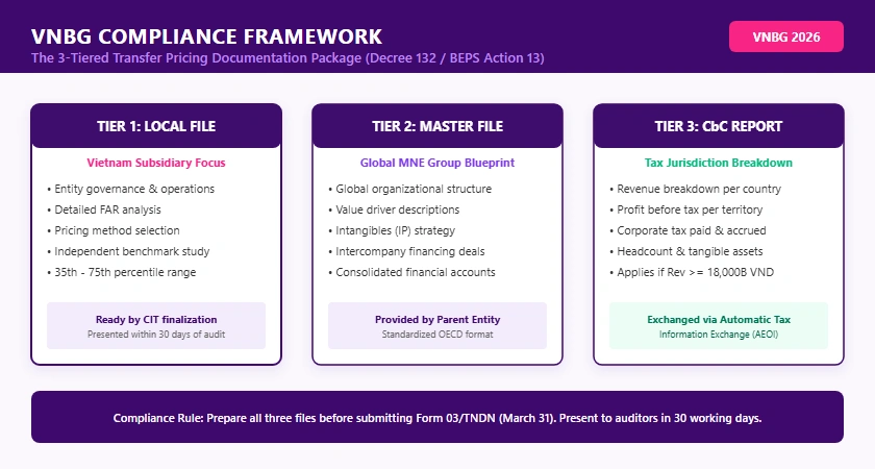
3-Tiered Transfer Pricing Documentation
The Local File
The Local File focuses on the Vietnamese subsidiary and contains: – Detailed corporate background, management structure, and local business strategy. – Comprehensive FAR analysis of local operations. – Full schedule of all related-party contracts, transaction volumes, and payment flows. – Economic analysis justifying the chosen transfer pricing methodology. – Independent commercial benchmarking search report demonstrating that local operating margins fall within the 35th to 75th percentile range.
The Master File
The Master File provides an overview of the multinational enterprise (MNE) group: – Global organizational and ownership structure. – Description of the group’s principal business drivers and supply chain models. – Strategy regarding ownership, development, and protection of group intangibles (IP). – Description of intercompany financing arrangements, cash pooling, and central treasury hubs. – Consolidated audited financial statements of the global corporate parent.
The local subsidiary typically receives this document directly from the foreign corporate headquarters.
Country-by-Country Report
The Country-by-Country Report provides tax authorities with global operational data: – Country-by-country breakdown of group revenue, pre-tax operating profits, corporate income tax paid, stated capital, accumulated earnings, headcount, and tangible physical assets. – Mandatory for multinational corporate groups with global consolidated revenue exceeding 18,000 billion VND (~$750 million EUR) in the preceding tax year.
Preparation and Submission Timelines
- Preparation Deadline: The three-tiered documentation package must be completed before filing the annual Corporate Income Tax return (within 90 days of the fiscal year-end, or March 31 for calendar-year businesses) and archived locally.
- Audit Production Timeline: If tax inspectors issue an audit request, the enterprise must present its completed Local File and Master File within 30 working days. A single extension of up to 15 working days may be granted upon valid written application.
Safe Harbor Exemptions: Who Is Exempt from Documentation?
To reduce compliance costs for small businesses, Decree 132 provides four safe harbor exemptions from preparing Local and Master Files:
| Exemption Type | Qualification Criteria | Retained Obligations |
| Small Revenue & Low RPT | Total revenue < 50 billion VND AND related-party transactions < 30 billion VND | Exempt from Local & Master Files; must submit disclosure Appendix I |
| Simple Functions & High Margin | Total revenue < 200 billion VND AND net operating profit reaches: Distribution >= 5%, Manufacturing >= 10%, Processing/Toll >= 15% | Exempt from Local & Master Files; must submit disclosure Appendix I |
| Advance Pricing Agreement | Formal APA executed with the General Department of Taxation | Exempt for covered transactions; must file annual APA compliance report |
| Purely Domestic Operations | Both related entities operate in Vietnam, pay identical tax rates, and enjoy no tax holidays | Completely exempt from TP documentation |
Companies qualifying for safe harbor exemptions remain subject to the 30% EBITDA interest deduction cap and must submit Appendix I with their annual CIT finalization return.
Transfer Pricing Audits, Penalties, and Defense Strategies
Tax authorities select transfer pricing audit targets using data-driven risk profiling.
Common Transfer Pricing Audit Triggers
- Reporting consecutive operating losses for 2 to 3 years while expanding local factory facilities, purchasing capital machinery, or hiring staff.
- Generating operating margins significantly below the published average for comparable companies in the same province or economic zone.
- Paying high intellectual property royalties or management consulting fees to overseas parent entities located in low-tax jurisdictions.
- Holding high intercompany debt balances that incur interest expenses exceeding the 30% EBITDA cap.
Consequences of Audit Adjustments
When tax inspectors establish that an enterprise has under-declared profits:
- Arbitrary Tax Assessment: The tax authority recalculates revenue or disallows intercompany deductions, adjusting operating margins to the median (50th percentile).
- Under-Declaration Penalty: A statutory 20% fine on the deficient corporate income tax amount.
- Late-Payment Interest: An ongoing statutory charge of 0.03% per day (approximately 10.95% annually) calculated from the date the tax was originally due.
- Retroactive Multi-Year Audits: Tax authorities can audit transfer pricing records across a 10-year statutory period, multiplying financial exposure across multiple open years.
Proactive Audit Defense Strategies
- Perform contemporaneous documentation: Compile your Local File and benchmark searches before submitting your annual CIT return. Retroactively creating benchmarking studies during an audit often leads to rushed datasets that auditors reject.
- Monitor margins quarterly: Track your operating profit margins every quarter against your benchmark range. If unexpected supply chain costs push your margin below the 35th percentile, adjust intercompany transfer prices before the fiscal year ends.
- Maintain detailed economic evidence: Compile project milestone sign-offs, timesheets, and cost allocation sheets to substantiate every management fee and technical service payment.
Partner with Vietnam Business Gateway (VNBG)
Transfer pricing compliance requires coordination between corporate strategy, economic benchmarking, and domestic tax administration.
Vietnam Business Gateway (VNBG) serves as your operational arm in Vietnam. Since 2018, our multidisciplinary team of tax professionals, corporate accountants, and legal advisors has guided more than 300 international corporations, manufacturing operations, and technology firms through Vietnamese regulatory requirements.
Our transfer pricing services include:
- Conducting detailed Functional, Asset, and Risk (FAR) analyses to characterize your business correctly.
- Performing defensible commercial benchmarking searches using recognized financial databases to establish your 35th to 75th percentile arm’s length range.
- Authoring compliant three-tiered transfer pricing packages, including Local Files, Master File adaptations, and CbCR filings.
- Preparing and filing accurate Appendix I through IV disclosure schedules before annual deadlines.
- Representing your enterprise during transfer pricing audits to defend your intercompany margins and protect your business against arbitrary tax assessments.
- Protect your company’s profits and ensure compliance with Vietnamese tax law. Contact Vietnam Business Gateway today to schedule a confidential transfer pricing and intercompany transaction review.
Official Regulatory Portals:
General Department of Taxation of Vietnam (gdt.gov.vn)
OECD Transfer Pricing Guidelines Portal (oecd.org/tax/transfer-pricing/)