

The labor market and human resources supply sector in Vietnam are currently undergoing one of the most profound legislative and administrative structural transformations in the past decade. For foreign investors planning to set up a labor sub-leasing company in Vietnam in 2026, the legal landscape has shifted dramatically in favor of ease of doing business and operational flexibility.
Recently, the Vietnamese Government officially enacted Resolution 66.17/2026/NQ-CP and Resolution 66.18/2026/NQ-CP. These landmark regulations have fundamentally altered the incorporation and operational framework for labor sub-leasing services. Most notably, the labor sub-leasing industry has been removed from the list of conditional business lines that require a strict, pre-approved sub-license.
Why should foreign investors and HR agencies care about this? This strategic move by the government cuts through layers of red tape, allowing investors to establish their presence and commence operations almost immediately. However, this ease of entry comes with a critical trade-off: a rigorous shift towards “post-market compliance.”
In this comprehensive legal breakdown, we will analyze the impacts of these new resolutions, compare the old and new incorporation procedures, outline the strict operational and reporting obligations you must adhere to, and provide actionable compliance strategies to ensure your business thrives securely in the Vietnam market.
Key Takeaways
Before diving into the intricate legal analysis, here is a quick overview of the most critical updates regarding labor sub-leasing service requirements:
- Abolition of the Sub-License: The new regulations remove the business from the conditional business list; no specialized operating license is required before providing the services.
- Paradigm Shift in Management: The government has transitioned from a “pre-check” (Tiền kiểm) model to a “post-check” (Hậu kiểm) regulatory framework.
- Streamlined 5-Step Process: “What are the steps to establish a labor sub-leasing company in Vietnam after July 2026?” The process is now faster, focusing purely on corporate establishment and local authority notification.
- Strict Operational Scrutiny: While entry is easy, maintaining operations requires meticulous adherence to compliance reports, escrow deposits, and labor rights.
- Permitted Job Categories: Labor Sub-leasing is legally restricted to a specific list of 20 job positions, which companies must strictly observe.
- Strategic Adaptation: Both new entrants and existing firms must pivot their legal strategies to focus on internal audits and audit-readiness.
What Are the Core Changes of Labor Sub-Leasing Business Requirements?
In the context of these new regulatory documents, what exactly changes the process of establishing a labor sub-leasing company in Vietnam?
Previously, under the Labor Code 2019 and Decree 145/2020/ND-CP, labor sub-leasing was heavily guarded. After obtaining standard corporate licenses, companies had to wait months to be granted a Labor Sub-leasing Operation License by the Department of Labor, Invalids and Social Affairs (DOLISA).
The promulgation of Resolution 66.17/2026/NQ-CP officially strips “labor sub-leasing services” from Annex IV of the Investment Law (the list of conditional business lines). Consequently, Resolution 66.18/2026/NQ-CP abolishes the procedures for issuing, extending, and re-issuing this specific sub-license.
This signifies a transition from “Pre-check” to “Post-check”. While these terms are not explicitly defined in the statutory text, in Vietnamese legal practice, they represent a monumental shift.
“Pre-check” means proving your capability before being allowed to operate. “Post-check” means the government trusts you to enter the market swiftly, but will rigorously monitor your ongoing activities through mandatory compliance reports and sudden inspections. You no longer need to wait for a physical paper license to sign your first client, but you remain strictly bound by the underlying operational conditions.
The New Labor Sub-Leasing Company Incorporation Procedure
A common question we receive from global partners is: “What are the steps to establish a Labor sub-leasing company in Vietnam after July 2026?” Previously, the timeline was hindered by the lengthy sub-license application. Today, the process is streamlined into five actionable steps:
- Step 1: Obtain the Investment Registration Certificate (IRC). Mandatory for foreign investors, this step approves the foreign direct investment project in Vietnam.
- Step 2: Obtain the Business Registration Certificate (BRC). The company must be incorporated with the specific Vietnam Standard Industrial Classification (VSIC) code 7830 (Supply and management of labor resources).
- Step 3: Fulfill the Escrow Deposit. “Do I need a deposit to open a Labor sub-leasing company in Vietnam under new law?” – Yes. You must deposit 2,000,000,000 VND (approx. USD 80,000) at a commercial bank in Vietnam as an unchanged prerequisite.
- Step 4: Official Notification. Within a strict timeframe (usually 20 working days) from the start of operations, the company must publicly announce its establishment and notify the local Department of Home Affairs/DOLISA.
- Step 5: Commence Operations. You may immediately begin signing contracts with clients, provided you strictly adhere to the 20 permitted labor sub-leasing job categories.
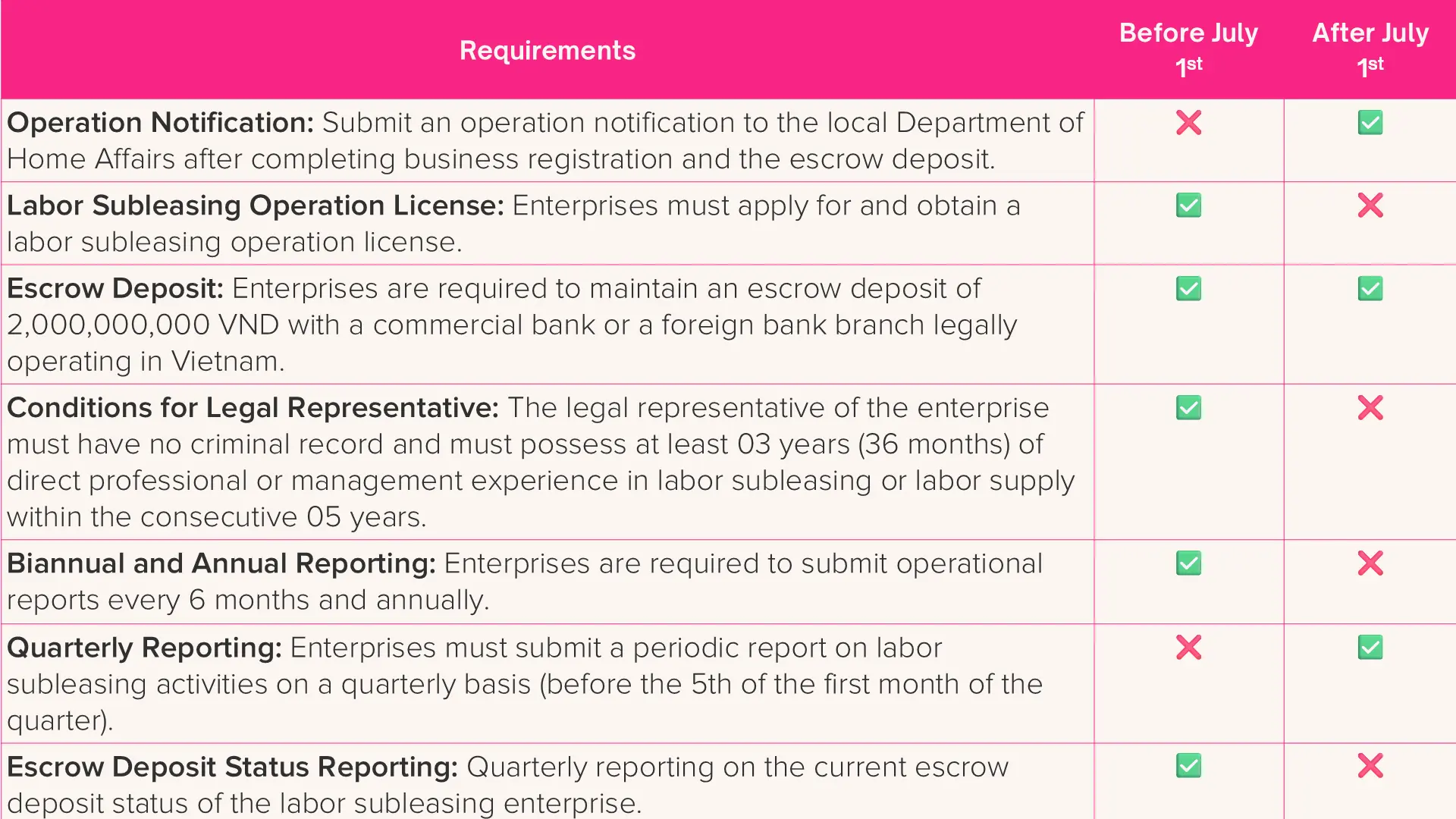
Comparison of Labor Sub-Leasing Company Requirements Before Vs After July 1st, 2026
Permitted labor Sub-Leasing Job Categories (The 20 Allowed Positions)
A crucial aspect of compliance that remains entirely unchanged by the new resolutions is the scope of services you can provide. Under Vietnamese labor law, a labor sub-leasing company cannot outsource workers for just any position.
To avoid administrative penalties and the invalidation of service contracts, companies must strictly restrict their services to the following 20 legally permitted job categories:
| No. | Permitted Job Category | No. | Permitted Job Category |
| 1 | Translation / Interpretation / Shorthand | 11 | Document Editing |
| 2 | Secretary / Administrative Assistant | 12 | Bodyguard / Security Guard |
| 3 | Receptionist | 13 | Telemarketing / Customer Service |
| 4 | Tour Guide | 14 | Financial and Tax Processing |
| 5 | Sales Support | 15 | Automobile Repair / Operational Inspection |
| 6 | Project Support | 16 | Scanning, Industrial Technical Drawing / Interior Decoration |
| 7 | Production System Programming | 17 | Driving |
| 8 | Production and Installation of TV/Telecom Equipment | 18 | Management, Operation, Maintenance & Service on Seagoing Ships |
| 9 | Operation, Inspection, and Repair of Construction Machinery & Production Electrical Systems | 19 | Management, Supervision, Operation, Repair, Maintenance & Service on Oil and Gas Rigs |
| 10 | Cleaning of Buildings and Factories | 20 | Piloting, Aircraft Service, Maintenance, Flight Dispatch & Supervision |
Note: For broad categories such as “Sales Support” or “Project Support,” it is highly recommended to explicitly define the project scope and duties within the commercial contract to align seamlessly with statutory definitions during an audit.
Transforming Legal Concepts into Strategic Action and Compliance
During operations, what regulations must a labor sub-leasing company adhere to? The removal of the sub-license is not a free pass; it is a redirection of legal responsibility.
Mandatory Compliance Reports: Under the new regulations (specifically Resolution 66.18/2026/NQ-CP), the reporting frequency and the governing body have fundamentally changed. Enterprises are now obligated to submit meticulous compliance reports regarding their labor utilization on a quarterly basis (deadline: before the 5th of the first month of the quarter). Moreover, these reports must now be submitted to the Department of Home Affairs instead of DOLISA. These reports track the number of outsourced workers, their assigned locations, and contract durations.
Obligations to Outsourced Workers: The core essence of labor sub-leasing remains fiercely protected. The labor sub-leasing company is the legal employer. You must ensure that the outsourced worker’s salary is not lower than that of a direct employee of the client performing the same job. Furthermore, you must fully handle all mandatory social insurance, health insurance, unemployment insurance, and other types of security contributions.
Information Management & Corporate Changes: If your business undergoes structural changes—such as relocating the headquarters, opening a new branch, pausing operations, or changing the legal representative—you must notify the governing bodies (DOLISA/Department of Home Affairs) immediately, updating your status on the national employment transaction portal.
Document Readiness for Authorities Check
“If my company is selected for a post-check inspection, what documents do I need to prepare?”
The absence of a sub-license means the government will verify your capability while you are operating. When an inspection delegation arrives, failing to produce evidence of compliance can result in severe administrative fines or forced suspension. You must maintain a pristine “post-market compliance” portfolio, including but not limited to:
- Financial Security: The original bank certificate proving the 2 Billions VND (~ USD 80.000) escrow deposit remains untouched and fully funded.
- Notifications & Reporting Records: Proof of operation notifications or updates sent to the Department of Home Affairs at both your headquarters and operational locations (submitted online or via post). Additionally, you must maintain a complete dossier of your quarterly compliance reports (submitted before the 5th of the first month of each quarter) sent to these authorities.
- Corporate & Labor Documentation: Your Business Registration Certificate (Company License), Work Permits for foreign staff (if any).
- Contractual Agreements: All properly executed commercial outsourcing contracts with your clients and labor contracts with your outsourced workers.
In short, the underlying standards required to run a labor sub-leasing business have not disappeared; they have simply been shifted to the background. Investors must proactively prepare these documents, treating everyday operations with the same rigor as a license application.
Adapting to the New Regulations in Your Business Plan
“I am aware of these changes, but what should my immediate action plan be?”
The impact of these resolutions varies depending on your current business lifecycle stage. We categorize investors into two distinct groups, each requiring a tailored approach:
Group 1: Investors Planning to Enter the Market If you are planning to set up a labor sub-leasing company in Vietnam 2026, you hold a distinct advantage. The barrier to entry has been drastically lowered, allowing you to expedite your go-to-market strategy. However, do not let the speed of incorporation blind you to operational risks. Your strategy should shift from “how to get the license” to “how to build a compliant infrastructure.”
To ensure you are fully compliant and audit-ready before you even begin the incorporation process or sign your first service contract, you must complete the following Pre-Establishment Compliance Checklist:
- Prepare Escrow Capital: Allocate and ready the 2,000,000,000 VND (approx. USD 80,000) specifically for the mandatory escrow deposit. You must be prepared to deposit this at a local commercial bank immediately after receiving your Enterprise Registration Certificate (ERC) and before officially providing any labor sub-leasing services.
- Secure a Legitimate Physical Office: Post-market audits will rigorously verify your operational presence. Secure a stable, long-term commercial lease agreement for a physical office space and strictly avoid “virtual office” setups.
- Map Services to Permitted Categories: Review your intended service offerings against the 20 legally permitted labor sub-leasing job categories. Draft your commercial contracts and labor contracts to explicitly reflect these exact legal definitions to avoid non-compliance.
- Establish HR & Payroll Infrastructure: Set up a robust payroll system capable of ensuring wage parity (outsourced workers cannot be paid less than direct employees performing the same role) and managing complex social, health, and unemployment insurance contributions flawlessly from Day 1.
Group 2: Existing labor Sub-Leasing Agencies in Vietnam For those already operating, the era of stressing over license renewals is over. Your primary focus must now pivot to internal auditing and risk management. Authorities will increasingly rely on data cross-matching (tax, social insurance, and labor reports) to trigger inspections. To ensure absolute compliance under the new post-check mechanism, existing agencies should execute the following Post-Market Compliance Audit Checklist:
- Audit Past Reporting Obligations: Review your historical submissions. Ensure that all bi-annual (due June 20th) and annual (due December 20th) compliance reports regarding labor utilization have been accurately filed with DOLISA/Department of Home Affairs up to the current date. Rectify any missing or delayed reports immediately to clear your regulatory backlog. Moving forward, update your internal calendar for the new quarterly reporting requirement (due before the 5th of the first month of each quarter) to the Department of Home Affairs.
- Review Current Labor Contracts & Wage Parity: Audit all active outsourcing contracts. Verify that outsourced workers are currently receiving wages and benefits equal to or greater than your clients’ direct employees performing the same roles. Address any discrepancies to avoid labor disputes and administrative fines.
- Upgrade SOPs (Standard Operating Procedures): Revamp your internal HR and compliance SOPs to align with the new post-check reality. Create strict internal timelines and assign specific personnel to monitor upcoming reporting deadlines, as well as trigger events (like office relocation, changing the CEO, or opening a new branch) that now require immediate notification to the authorities.
- Prepare a “Ready-to-Inspect” Document Portfolio: Collate and securely store all critical operational documents for future, unannounced inspections. This portfolio must include the legal representative’s qualification proofs, active commercial lease agreements, ongoing social insurance contribution receipts, and the untouched 2 billion VND escrow deposit certificate.
Please note that the checklists provided above are for reference purposes only. In practice, each inspecting officer or regulatory delegation may have varying requirements, and you may be requested to prepare and submit additional documentation.
Your Partner in Vietnamese Business Compliance
To summarize, Resolutions 66.17 and 66.18 represent a progressive leap for the Vietnam labor sub-leasing market. By removing the sub-license requirement and adopting a post-market compliance model, the government empowers investors to move faster. However, the obligation to maintain an escrow deposit, manage strict labor rights, and submit timely compliance reports means that legal vigilance is more critical than ever.
At Vietnam Business Gateway (VNBG), we are not just a service provider; we are your built-in local team and partner from day one. We approach business setup with the spirit of a traditional artisan: precise, patient, and committed to perfection.
If you are looking to capitalize on these new regulations, VNBG offers a compliance-first, cost-effective, and one-stop solution. From seamless corporate incorporation to managing the intricacies of your monthly payroll, HR compliance, and mandatory reporting, we handle the local complexities so you can focus on growing your global ambition.
Ready to set up your labor sub-leasing business securely? Reach out to VNBG today for a free consultation and let us turn your outside perspective into inside success in Vietnam.