Vietnam’s Tourism Market is Moving Faster Than Most Investors Realize
Vietnam’s tourism industry is accelerating at a pace that has caught even seasoned regional investors off guard. By the end of 2025, the country had welcomed 21.2 million international visitors, generating total tourism revenue approaching 1 quadrillion Vietnamese dong. In just the first four months of 2026 alone, Vietnam recorded 8.8 million international arrivals — a 14.6% increase over the same period in 2025 — already 35% of the government’s full-year target of 25 million visitors.
The Vietnamese government is not leaving this momentum to chance. Through a sweeping reform of its visa policy — including a 90-day e-visa valid for most nationalities, multiple-entry access through 42 international border gates, and unilateral visa exemptions of up to 45 days for citizens of 24 countries, including Germany, France, the UK, Italy, and Spain — Hanoi is systematically removing the friction that once discouraged high-spending international travelers from choosing Vietnam over Thailand or Singapore.
For foreign investors, the signal is clear: Vietnam’s international tourism market is open, growing, and increasingly sophisticated. The question is no longer whether to enter this market — it is how to enter it correctly.
And that is precisely where many foreign-owned companies stumble.
International tourism in Vietnam is classified as a conditional business sector. This means that regardless of how a company is structured, how much capital it brings to the table, or how experienced its management team is, no business entity — foreign or domestic — may legally provide international tour operator services without first obtaining a specific operating licence from the national authority: the International Tour Operator Licence.
This article is written specifically for foreign direct investment (FDI) companies and foreign investors who are either already established in Vietnam or actively planning to enter the market. It covers what this licence authorizes, what conditions must be met to obtain it, the documents required, how the application process works, and what your compliance obligations look like after the licence is granted.
The Most Important Thing FDI Companies Must Understand — The Scope Boundary
Before discussing conditions or paperwork, there is one fundamental concept that every foreign investor must internalize before entering Vietnam’s travel services market. It is the single most consequential legal boundary that separates FDI travel companies from their Vietnamese counterparts — and ignoring it, even accidentally, can result in fines of up to VND 100,000,000 per violation, suspension of operations for 12 to 24 months, or permanent licence revocation.
Vietnamese law divides the travel services market into three separated segments:
- Inbound Tourism — Tour programs that bring international visitors into Vietnam.
- Domestic Tourism — Travel services for people traveling within Vietnam’s borders.
- Outbound Tourism — Organizing tours that take people out of Vietnam to travel abroad.
What Foreign-owned Travel Agencies Are Permitted to Do?
Foreign-owned travel agencies are authorized to operate exclusively in the Inbound segment. This means your company may legally:
- Design and package Inbound tour programs for international visitors coming to Vietnam
- Market and sell these programs through global distribution channels
- Directly manage the on-the-ground experience for your international guests once they arrive
- Provide domestic travel components (for example, a Hanoi–Hoi An segment or a Mekong Delta day trip) as an integral and inseparable part of the Inbound package your company has already sold to that same international guest
That final point deserves emphasis. An FDI company may include domestic travel elements within its Inbound offering — but only as a bundled component for guests your company has already brought into the country. You cannot separately design, market, or sell stand-alone domestic tour packages to Vietnamese residents.
What Foreign-owned Travel Agencies Are Strictly Prohibited from Doing?
FDI companies — regardless of the ratio of foreign ownership, regardless of the size of the Vietnamese partner’s stake — are absolutely prohibited from operating in the Outbound segment.
This is not an oversight in the law. It is a deliberate policy position that Vietnam has consistently maintained across all of its international trade commitments, including its WTO Schedule of Specific Commitments, the EU-Vietnam Free Trade Agreement (EVFTA), and the Comprehensive and Progressive Agreement for Trans-Pacific Partnership (CPTPP).
In practice, this means an FDI company cannot:
- Design or sell tour packages for Vietnamese citizens or foreign residents in Vietnam who want to travel abroad
- Act as an agent, sub-contractor, or referral partner that funnels outbound travelers to an international operator
- Use a Vietnamese partner company to conduct Outbound operations on its behalf
- Use a branch office, representative office, or any other corporate vehicle to provide Outbound services in any form
The risk here is not theoretical. Vietnam’s Ministry of Culture, Sports and Tourism conducts active inspections of FDI travel companies, particularly scrutinizing revenue streams and product portfolios for signs of Outbound activity. Any attempt to structure around this prohibition — regardless of how the commercial arrangement is labeled — will be treated as a violation.
If your business model requires Outbound capability, the only lawful path available to you at present is to structure a separate domestic Vietnamese company (not an FDI entity) to handle that segment.
Why This Matters Before You Apply the License?
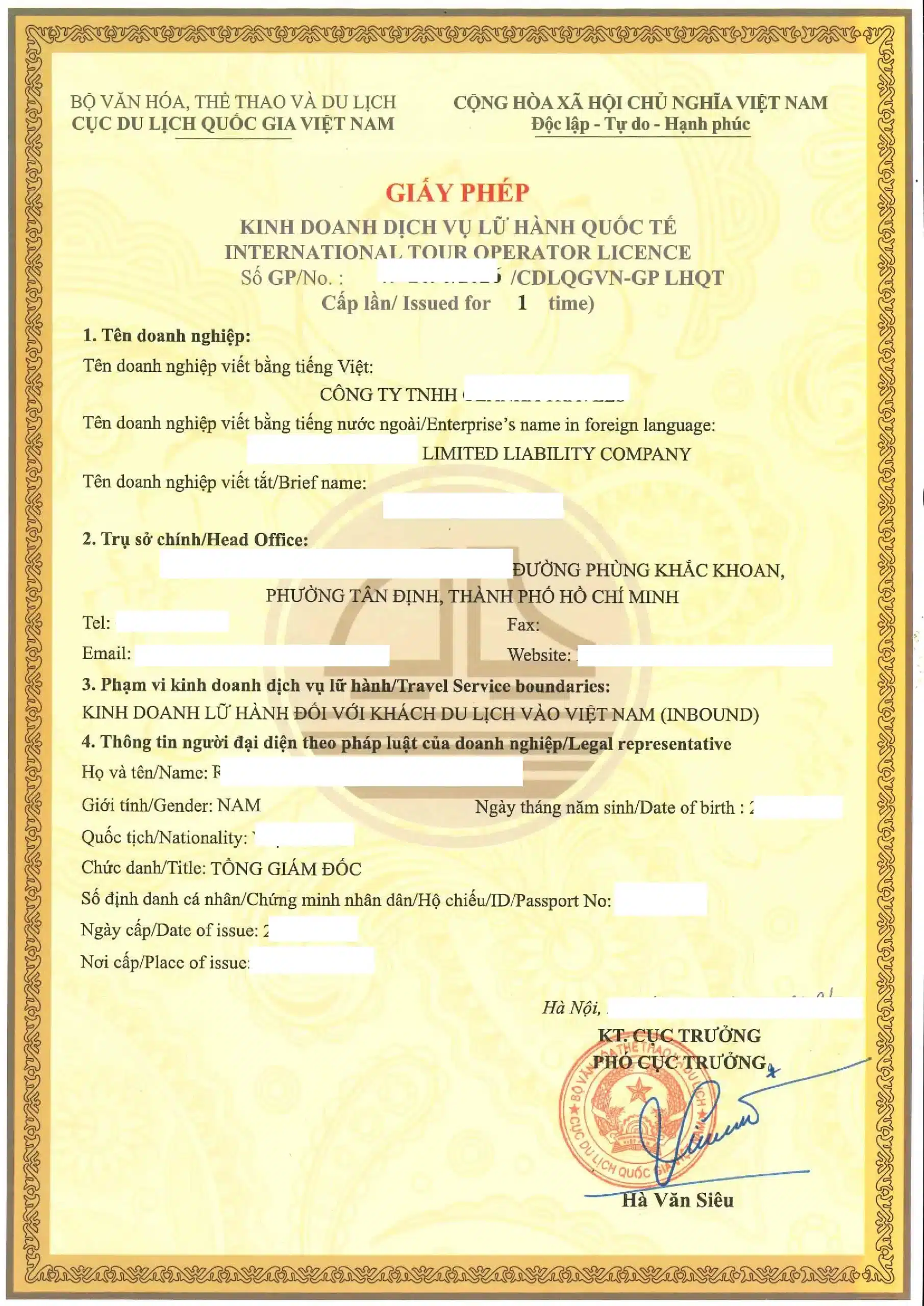
We explain this boundary in detail at the outset because it directly affects how you structure your business, how you draft your Articles of Association, and how you register your business activities with the licensing authority. The licence itself — as shown in the official specimen issued by Vietnam National Authority of Tourism (VNAT) — explicitly states on its face: “Kinh doanh lữ hành đối với khách du lịch vào Việt Nam (INBOUND)”. There is no ambiguity in what is permitted.
Acknowledging this information before you apply will save you from building a business plan that is incompatible with your legal licence, and from the compliance exposure that comes from operating outside its boundaries.
The Three Core Conditions for Obtaining the Licence
Vietnam’s Tourism Law (Law No. 09/2017/QH14), along with its implementing Decree 168/2017/ND-CP and Circular 06/2017/TT-BVHTTDL, establishes three mandatory conditions that every applicant — domestic or foreign-owned — must satisfy before the licence can be granted. Think of these as three non-negotiable pillars. All three must be in place simultaneously at the time of application.
Pillar 1: Legal Entity Status — Structure and Business Establishment
Your company must be a validly incorporated legal entity in Vietnam. For FDI companies specifically, this means holding:
- a) Investment Registration Certificate (IRC): Issued by the Department of Planning and Investment at the provincial level. This document formally records the foreign investment in Vietnam and defines the scope of the approved project.
- b) Business Registration Certificate (BRC): Your company’s founding document, confirming its legal existence and authorized business activities. For travel services licensing, your BRC must register the following industry code:
- Industry Code VSIC 7911: Travel agency activities
- Industry Code VSIC 7912: Tour operations
- Industry Code VSIC 7990: Other reservation service and related activities
You can also register Industry Code VSIC 5229 and 7990 – Services related to arranging travel tours, to support clients to book accommodation, hotels, bus tickets… Depending on your business plan and structure.
This code must appear on your BRC before you can apply for the licence. If your company is registered under other business codes without the business codes above, you will need to amend your BRC first.
What about the structure of the FDI entity?
Under Vietnam’s WTO Schedule of Specific Commitments for Services (CPC 7471 — Travel agency and tour operator services), foreign investors are not permitted to establish a 100% foreign-owned company for the purpose of operating travel services in Vietnam. CPTPP allows foreign investors from its members to be enabled to establish a 100% foreign-owned company, but the government still does not issue new regulations to guide in detail hence now we are still waiting for a guidance decree/circular.
The only legally recognized form of commercial presence for FDI in this sector is a Joint Venture (JV) — a company jointly owned by the foreign investor(s) and a Vietnamese corporate partner.
However, Vietnamese law does not impose any ceiling on how much of the joint venture the foreign side may own. In theory and in practice, a foreign investor may hold up to 99% or even 99.99% of the joint venture’s registered capital. The Vietnamese partner’s stake can be as small as 0.01% — it is the structural form of joint venture that the law requires, not a meaningful minimum shareholding for the Vietnamese side.
What must the Vietnamese partner be?
The Vietnamese partner in your joint venture cannot be just any individual or company. Under the WTO commitment and the Tourism Law, the Vietnamese corporate partner is required to be a legal entity (not an individual) that already holds a valid international tour operator licence of its own.
This means your Vietnamese JV partner must already be an established, licensed travel agency. A newly formed Vietnamese company without a licence, a holding company, or an individual investor cannot fulfill this role.
If you are structuring an FDI travel company from scratch, coordinating the establishment of a qualified Vietnamese partner entity is typically the most time-sensitive step in the entire process — and the one that most often delays the overall timeline.
Pillar 2: Financial Commitment — The Escrow Deposit
The second condition is a mandatory financial deposit placed with a licensed commercial bank in Vietnam. This is not a fee, not a tax, and not a government payment. It is a blocked escrow account — a risk reserve that remains in your name but is inaccessible for ordinary business operations.
The required deposit amount for FDI companies operating in the Inbound segment is VND 250,000,000 (approximately USD 10,000 at current exchange rates).
The purpose of this escrow is clearly defined by law: the funds may only be accessed in exceptional emergency circumstances, such as evacuating stranded tourists, covering urgent medical expenses for travelers injured during a tour, repatriating the remains of tourists who die while under your company’s care, or compensating tourists in the event your company becomes insolvent.
The funds sit in a blocked account and earn interest in the normal course, but they cannot be deployed for working capital, investment, or any other business purpose. If the account is ever drawn down due to a claim event, your company is legally required to replenish it to the full VND 250,000,000 balance within 30 days.
How to set up the escrow account?
Contact a commercial bank in Vietnam (or the Vietnam branch of a foreign bank licensed to operate in Vietnam) and request to open an escrow account specifically designated as a “travel service business security deposit” (tài khoản ký quỹ kinh doanh dịch vụ lữ hành). The bank will issue a formal Certificate of Escrow Deposit (Giấy chứng nhận tiền ký quỹ kinh doanh dịch vụ lữ hành quốc tế) once the funds are transferred and blocked.
This certificate is one of the most critical documents in your licence application. Without the original certificate, the licensing authority will not accept your application file.
Pillar 3: Human Capital — The Qualified Business Manager and Personnel
The third condition is perhaps the most operationally challenging for FDI companies — not because the requirement is unreasonable, but because it demands significant advance planning. Under the Tourism Law, every licensed travel company must designate a “Person in Charge of Travel Business Operations” (Người phụ trách kinh doanh dịch vụ lữ hành). This individual — typically the General Director, CEO, or Head of Operations — must personally satisfy specific academic and professional qualifications.
The qualification requirements for the Manager
Option A — Direct academic qualification: The Person in Charge must hold a degree of at least College level or above, with a major specifically in one of the following fields as listed in Circular 06/2017/TT-BVHTTDL:
- Travel and tourism service management
- Travel business management
- Tour operation
- Tourism marketing
- Tourism
- Travel and tourism
- Tourism management and business
Option B — Alternative pathway: If the designated Person in Charge holds a college or university degree in any other field — such as business administration, finance, economics, or law — they may still qualify by completing a short-course training program and obtaining the Certificate of International Tour Operation Management Skills (Chứng chỉ nghiệp vụ điều hành du lịch quốc tế). This certificate is issued only by institutions approved by the Ministry of Culture, Sports and Tourism.
For foreign managers holding overseas degrees:
If the Person in Charge holds a degree from a foreign educational institution, the credential must go through a formal recognition process:
- Consular legalization (apostille or legalization chain) at the relevant Embassy
- Certified notarized Vietnamese translation of the degree
- Degree equivalency recognition from the Department of Educational Quality Management under Vietnam’s Ministry of Education and Training
This process can take few weeks depending on the country of issue. FDI companies should initiate this process as early as possible — ideally before the company is even formally registered.
Requirements for Tour Guides
In addition to the personnel requirements, FDI travel agencies need to be aware of a strict requirement governing the tour guides they may employ. Vietnamese law — consistently maintained across WTO, EVFTA, and CPTPP commitments — mandates that all tour guides who accompany and guide international tourist groups on Vietnamese territory must be Vietnamese citizens holding a valid International Tour Guide Card issued by the provincial Department of Tourism.
FDI companies cannot hire foreign nationals as practicing tour guides, regardless of their language skills, experience, or the nationality of the tourist group they are serving. This restriction is non-negotiable.
To obtain an International Tour Guide Card, a Vietnamese candidate must:
- Hold a relevant university or college degree in tourism, foreign languages, or a related field
- Pass a professional examination organized by the provincial tourism authority, covering knowledge of tourism law, destination expertise, and guiding skills
- Demonstrate fluency in at least one foreign language at the required examination level
Planning your guide staffing accordingly — recruiting, training, and verifying the card status of your guides — should be built into your operational preparation timeline well before launch.
Document Checklist — What You Need to Prepare
The National Tourism Administration is known for rigorous document review. A single missing certification, an uncertified copy where the original is required, or an incomplete stamp can result in your application being returned for correction — resetting the processing clock. Preparing a complete, correctly formatted dossier before submission is essential.
The complete application dossier for an FDI company includes:
- Application Form: Drafted using the standardized form Mẫu số 04, Phụ lục II (Form No. 04, Appendix II) of Circular 06/2017/TT-BVHTTDL. Available on the Ministry of Culture, Sports and Tourism’s online public service portal. No substitute format will be accepted.
- The Business Registration Certificate (BRC): Confirming your company’s legal existence, registered address, and business activities, including Business Codes for Travel Service Businesses.
- The Investment Registration Certificate (IRC): Required specifically for FDI companies — demonstrates the legal status of the foreign investment and confirms the approved scope of the project.
- Original Escrow Deposit Certificate: The original (not a copy) of the Certificate of Escrow Deposit issued by the bank, showing the full VND 250,000,000 (Two hundred and fifty thousand VND) deposit and confirming the account is currently blocked and active. Copies are not accepted for this item.
- The Academic Qualification of the Person in Charge:
- Option A: The college/university degree in a qualifying tourism major.
- Option B: The college/university degree, plus the Certificate of International Tour Operation Management Skills.
- Foreign degree: The official Degree Equivalency Recognition letter from the Ministry of Education and Training.
- Evidence of Employment Relationship with the Person in Charge: Confirming the individual is genuinely employed by your company. Acceptable evidence:
- A formal Appointment Decision (Quyết định bổ nhiệm) signed by the Board of Members or Board of Directors naming the individual to their position, OR
- A Labor Contract (Hợp đồng lao động), either open-ended or fixed-term, between the company and the individual
- The Licensing Fee Receipt:
When submitting the dossier, the enterprise must pay a mandatory state appraisal fee. It is crucial for financial controllers to note a significant, time-bound stimulus policy regarding this fee.
Historically, the fee for a new International Tour Operator License was 3,000,000 VND. However, recognizing the need to accelerate the post-pandemic recovery of the tourism sector and to encourage FDI entities to formalize their operations, the Ministry of Finance instituted a massive fee reduction. Under Circular 153/2025/TT-BTC and Circular 64/2025/TT-BTC, for the entirety of the year 2026 (from January 1 to December 31, 2026), the appraisal fee has been slashed to just 1,000,000 VND. The receipt or payment order confirming the transfer of this 1,000,000 VND to the State Treasury account of the Vietnam National Authority of Tourism must be included in the submission.
Important: If your application is reviewed and ultimately rejected after a full substantive review, the VND 1,000,000 fee is non-refundable. This underscores the importance of ensuring your dossier is complete and your company genuinely meets all three pillar conditions before submission.
The Licensing Process — Step by Step
Step 1: Confirm Pre-Conditions Are Met
Before preparing the application dossier, conduct an internal checklist:
- Does your BRC include business code VSIC 7911, 7912, 7990, or any other business codes that you wish to register?
- Is your escrow account funded at VND 250,000,000, and is the certificate in hand?
- Does your Person in Charge hold a qualifying degree, or have they completed the certificate course?
- If a foreign degree is involved, has the equivalency recognition been obtained?
Only proceed to submission once all of these are confirmed.
Step 2: Submit the Application
The receiving authority is:
Vietnam National Authority of Tourism – VNAT (Cục Du lịch Quốc gia Việt Nam)
Under the Ministry of Culture, Sports and Tourism
Head office: Hanoi, Vietnam
The Administration accepts applications through three channels:
- In-person submission at the one-stop counter at the Administration’s office in Hanoi
- Postal submission via Vietnam Post
- Online submission through the Ministry of Culture, Sports and Tourism’s online public service portal, or through the National Public Service Portal (preferred — fully digital Level 4 service with real-time tracking)
If you are headquartered outside of Hanoi, online submission is strongly recommended to avoid the coordination costs and delays associated with physical document delivery.
Step 3: Initial Review — Completeness Check
Upon receiving your application, the Administration conducts a first-pass review to confirm whether all required documents are present and formally valid. If anything is missing or incorrectly formatted, the Administration will issue a written notification requesting corrections. The processing clock only starts after all deficiencies are resolved and the application is confirmed complete.
This is why document preparation quality matters so much. A dossier that passes the initial review on the first submission is weeks ahead of one that requires even one round of corrections.
Step 4: Substantive Review and Verification — 10 Working Days
Once VNAT receives the dossier, the administrative clock begins ticking. By law, the regulatory body has exactly 10 working days from the receipt of a valid and complete dossier to conduct their appraisal.
This 10-day period is not merely a rubber-stamping exercise. VNAT officials will conduct deep cross-verifications. They will interface with the State Bank systems to verify that the escrow account genuinely exists and that the funds are actively blocked. They will also cross-reference educational databases to ensure the diplomas and certificates of the Person in Charge are authentic and not forged.
If the dossier is found lacking (e.g., a missing signature or an invalid degree), the clock stops. VNAT will issue a formal written notice requesting supplementary documents. The 10-day countdown resets only when the corrected dossier is resubmitted.
Step 5: Issuance of the License
Upon successful appraisal, the Director of VNAT will sign and issue the International Tour Operator License. Simultaneously, VNAT will send an official notification to the provincial Department of Tourism where the FDI enterprise is headquartered, formally placing the company under local administrative supervision.
At this point, the FDI enterprise is legally authorized to commence its commercial Inbound travel operations.
Post-Licensing Compliance — Your Obligations After the Licence Is Granted
Receiving the licence is not the end of your compliance obligations — it is the beginning of an ongoing relationship with the regulatory framework.
Maintaining the Escrow Deposit
The VND 250,000,000 escrow must remain intact and fully funded for as long as your company holds the licence. If the account is drawn down due to a claim event, you must replenish it within 30 days. Any reduction below the required level is a compliance violation.
Updating the Licence When Key Information Changes
The licence is tied to specific company information. The following changes require you to apply for an amended or replacement licence:
- A change in the company’s legal name
- A change in the company’s registered head office address
- A change in the Person in Charge of Travel Business Operations
- A change in the company’s legal representative
For amendments, you submit a new application to the Vietnam National Tourism Administration with documentation supporting the change. The processing time is the same 10 working days.
If the licence is lost or physically damaged, you are required to report this to the police and the licensing authority, and to apply for a replacement. Lending or renting your licence to another party is strictly prohibited.
Periodic Reporting
Licensed travel companies are required to submit periodic activity reports to the Vietnam National Tourism Administration covering the volume of tourists received, revenue figures, and any incidents or claims that occurred during the reporting period.
Periodic and Annual Reporting Requirements:
- Monthly/Quarterly Reports: Companies must typically submit operational data by the 20th of the month following the reporting period.
- The Annual Report: This is the most critical compliance document of the year. By February 20th of the following year, the enterprise must submit a comprehensive annual statistical report.
Reports are increasingly digitized and must be submitted through the official government portal for travel management as well as submitted formally to the local Department of Tourism.
Grounds for Licence Revocation
Understanding what can get your licence revoked is just as important as understanding how to get it. The Tourism Law (Article 36) specifies the following mandatory grounds for revocation:
- The company ceases operations, is dissolved, or is declared bankrupt
- The company no longer satisfies one or more of the licensing conditions (escrow below threshold, Person in Charge no longer qualifies, etc.)
- The company fails to apply for a replacement licence when required by law
- The company’s activities harm national sovereignty, national interests, or security
- The company exploits tourism operations to illegally move people into or out of Vietnam
- The company lends or rents its licence to another entity
- The company fails to fulfill obligations under Article 37, Clause 1(i) of the Tourism Law, causing serious harm to tourists’ lives, health, or property
- The company submits fraudulent documents in any licence application
On top of revocation, operating outside the permitted scope of the licence — most critically, providing Outbound services as an FDI entity — can result in administrative fines of up to VND 100,000,000 per incident, operational suspension, and ultimately forced closure.
Questions Foreign Investors Frequently Ask
Q1: Does an FDI company need to apply for this licence immediately after the company is registered?
No — there is no legal deadline requiring you to apply for the licence within a specific timeframe after incorporation. However, you cannot legally provide any international travel services until the licence is granted. Most FDI companies find it most efficient to prepare the licence application in parallel with their final operational setup — hiring, office lease, IT systems — so that everything is ready to launch together.
Q2: Can the company start providing travel services before the licence is issued?
No. Providing travel services without a valid licence is a violation of the Tourism Law and subjects the company to administrative penalties. This includes signing contracts with hotels, airlines, and ground handlers for the purpose of operating tours — even if those tours have not yet departed. The licence must be in hand before commercial operations begin.
Q3: When transferring the escrow funds to the bank, which account should the company use to make the transfer?
This is a nuanced financial operation. As an FDI enterprise, you are required to have a Direct Investment Capital Account (DICA) to receive your initial foreign capital injections. However, the escrow account (Tài khoản ký quỹ) is a separate, specialized blocked account.
Typically, the foreign investor transfers the charter capital into the DICA. From the DICA, the funds are transferred to the company’s standard local Payment Account (VND). It is from this standard Payment Account that the company will execute the transfer of 250,000,000 VND to the newly established, specialized Escrow Account under the tripartite agreement with the bank. Ensure your Chief Accountant coordinates closely with your commercial bank to execute this flow correctly to satisfy both foreign exchange controls and tourism regulations.
Q4: If the company has two or more legal representatives, do all of them need to meet the qualification requirements?
No. The qualification requirements apply specifically to the designated Person in Charge of Travel Business Operations (Người phụ trách kinh doanh dịch vụ lữ hành) — a functional role, not necessarily synonymous with the legal representative title. A company may have multiple legal representatives, but only the individual specifically designated as the Person in Charge of Travel Operations needs to satisfy the degree or certificate requirements. That person must be formally appointed through a company resolution or labor contract, and this appointment must be documented in the application.
The Pathway Is Clear — If You Know the Rules
Securing an International Tour Operator License as an FDI enterprise in Vietnam is undeniably a rigorous endeavor. The government has carefully engineered a regulatory framework that balances the need for foreign capital and global expertise with the imperative to protect local enterprises, control foreign exchange, and safeguard national security.
By strictly adhering to the Inbound-only mandate, navigating the complexities of the Joint Venture requirement, locking in the financial escrow, and ensuring impeccable personnel qualifications, foreign investors can successfully unlock access to one of the world’s fastest-growing tourism markets. While the limitations may seem restrictive initially, a profound understanding of these laws transforms compliance from a bureaucratic hurdle into a strategic competitive advantage. It allows you to build a resilient, fully legitimate operation capable of capitalizing on Vietnam’s trajectory toward 50 million annual visitors.
Streamline Your Market Entry with VNBG
Navigating the intricacies of Vietnamese corporate law, from the initial investment registration to the final specialized licensing, requires precise, on-the-ground expertise. VNBG (Vietnam Business Gateway) is your premier partner in this journey.
We provide comprehensive, end-to-end solutions tailored specifically for foreign investors. Beyond seamlessly handling your corporate incorporation and orchestrating the complex International Tour Operator License application, the VNBG ecosystem offers robust operational support. We empower your growth through expert accounting and tax compliance, meticulous payroll processing, executive recruitment, Employer of Record (EOR) services, and more ensuring your travel business operates flawlessly from day one.
Ready to launch your tourism venture in Vietnam with absolute legal certainty?
to schedule a strategic consultation with VNBG’s legal and business experts today.